What Should I Never Say to My Contractor?
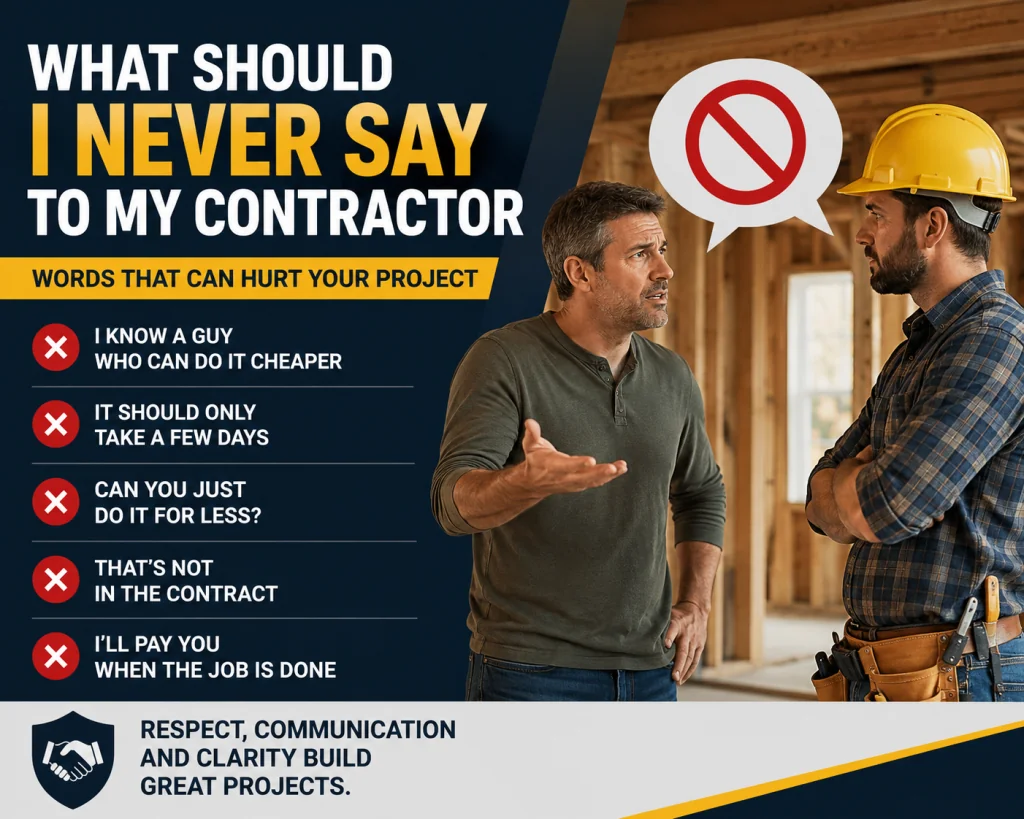
What Should I Never Say to My Contractor?
Introduction
In the construction industry, clear communication isn't just a courtesy—it's the foundation of every successful project. Whether you're a homeowner overseeing a kitchen renovation or a commercial developer managing a multi-million-dollar build, the words you choose when speaking with your contractor can either build trust or tear down the working relationship before the first nail is driven.
Yet, time and again, well-intentioned clients say things that create confusion, erode professionalism, inflate budgets, or invite legal complications. The gap between what you mean and what your contractor hears can cost thousands of dollars and months of delay.
This guide walks you through the phrases, assumptions, and communication habits you should never bring into a conversation with your contractor—and what to say instead.
1. "Just Do Whatever You Think Is Best."
Why It's Dangerous
Handing over creative and structural decisions without clear direction might feel like you're showing trust, but in reality, you're setting up a mismatch of expectations. Your contractor will make choices based on their experience, budget assumptions, and aesthetic preferences—which may not align with yours.
The Result
- Unapproved material selections
- Scope creep with no paper trail
- Disputes over "extra" charges you didn't anticipate
What to Say Instead
"Here's my vision, my priorities, and my budget ceiling. I'd value your professional recommendations within those parameters. Let's agree on a decision-making process before work begins."
2. "How Much Would It Cost If I Skip the Permits?"
Why It's Dangerous
Asking a licensed contractor to bypass permits or cut regulatory corners is not just inappropriate—it puts both parties at legal and financial risk. Unpermitted work can result in fines, forced demolition, voided insurance, and an inability to sell the property.
The Result
- Immediate erosion of professional respect
- Potential reporting to licensing boards
- Liability that follows you for decades
What to Say Instead
"Can you walk me through the permitting process, timelines, and associated costs so I can plan accordingly?"
3. "My Neighbor's Contractor Did It for Half the Price."
Why It's Dangerous
Every project has unique variables: site conditions, material grades, labor markets, insurance coverage, warranty terms, and scope details. Comparing quotes without identical specifications is like comparing two different buildings by their paint color.
The Result
- Puts your contractor on the defensive
- Pressures them to cut corners to "match" a vague number
- Undermines the value of quality workmanship
What to Say Instead
"I've received another estimate. Can we walk through the line items together so I understand where the differences in pricing come from?"
4. "I Saw a Video Online—Can You Just Do It That Way?"
Why It's Dangerous
Social media tutorials and viral renovation clips rarely show the structural, code, or engineering context behind a technique. Asking a contractor to replicate a 60-second video ignores site-specific conditions and professional judgment.
The Result
- Compromised structural integrity
- Code violations hidden behind "trendy" finishes
- Warranty issues when non-standard methods fail
What to Say Instead
"I saw an approach I liked aesthetically. Can we discuss whether it's feasible here, or if there's a better method to achieve the same look safely?"
5. "Can You Squeeze This In? It's a Small Change."
Why It's Dangerous
In construction, there is no such thing as a "small change." Moving a light switch may involve rerouting wiring, patching drywall, repainting, and re-inspecting. Casual verbal requests bypass the Change Order process, which protects both parties.
The Result
- Untracked scope additions
- Schedule disruptions that cascade
- Payment disputes at project close-out
What to Say Instead
"I'd like to discuss a potential change. Can you prepare a written change order outlining the cost, timeline impact, and any trade sequencing before we proceed?"
6. "I'm Not Paying Until Everything Is 100% Perfect."
Why It's Dangerous
Withholding all payment until subjective "perfection" is achieved is neither legally sound nor fair. Construction contracts are structured around milestones and substantial completion. Using payment as leverage for minor punch-list items damages the relationship and may violate contract terms.
The Result
- Contractors may legally lien your property
- Work stops mid-project
- You lose leverage for the actual punch-list items
What to Say Instead
"I'd like to establish a clear punch-list process and retainage structure in the contract so we're both protected through final completion."
7. "I'll Be Watching Every Day to Make Sure It's Done Right."
Why It's Dangerous
While staying informed is healthy, announcing constant surveillance signals distrust and micromanagement. Skilled tradespeople work best with autonomy, clear specs, and scheduled check-ins—not hovering.
The Result
- Lower crew morale and productivity
- Defensive, documentation-heavy interactions
- Talented subcontractors refusing future work with you
What to Say Instead
"I'd appreciate weekly progress meetings and photo updates. If I have questions between check-ins, who is my single point of contact?"
8. "Don't Worry About It in Writing—We Have a Handshake Deal."
Why It's Dangerous
Construction disputes are among the most common civil litigation cases precisely because verbal agreements dissolve under pressure. Without written contracts, scopes, schedules, and payment terms, both parties are exposed.
The Result
- No enforceable scope of work
- Ambiguous liability for defects
- Expensive legal battles over "what was said"
What to Say Instead
"Let's make sure every agreement, change, and approval is documented in writing—whether by email, a signed change order, or a contract addendum."
9. "I Need This Done by Friday. I Don't Care How."
Why It's Dangerous
Unrealistic deadlines communicated as ultimatums force contractors into impossible choices: rush and risk quality/safety, or refuse and risk losing the client. Neither outcome serves the project.
The Result
- Safety shortcuts
- Substandard workmanship
- Burned relationships with subs who walk off the job
What to Say Instead
"I have a firm deadline of [date]. Can we build a realistic schedule backwards from that and identify any constraints or acceleration costs upfront?"
10. "You're the Expert—Just Fix It." (After a Problem Arises)
Why It's Dangerous
When something goes wrong—water intrusion, a cracked slab, a failed inspection—vague delegation without a documented root-cause analysis invites finger-pointing later. You need a shared understanding of what failed, why, and who is responsible before remediation begins.
The Result
- Band-aid fixes that fail again
- Disputes over who bears the cost
- Missed insurance or warranty claims
What to Say Instead
"Let's document the issue together, determine the root cause, and agree in writing on the corrective scope, responsible party, and timeline before repairs begin."
Golden Rules of Client–Contractor Communication
| ✅ Do | ❌ Avoid |
|---|---|
| Put everything in writing | Relying on verbal promises |
| Ask questions to understand | Issuing ultimatums |
| Respect the chain of command | Bypassing the project manager to direct subs |
| Reference the contract | Making up rules mid-project |
| Give timely decisions | Disappearing for weeks at approval stages |
| Treat the crew with respect | Using payment as a weapon |
Final Thoughts
Your contractor is not an adversary, a mind-reader, or a subordinate—they are a skilled professional you've hired to execute a complex, high-stakes process. The single greatest predictor of a smooth, on-budget, on-schedule project isn't the brand of tile or the square footage. It's the quality of communication between client and contractor.
Avoid the phrases above, replace them with the alternatives suggested, and build your next project on a foundation of mutual respect, clarity, and documented agreements.
The blueprint for a great build starts long before the excavator arrives. It starts with the first conversation.
Found this article valuable?
Share it with fellow builders, architects, or download the QR code.
Written by Shanmugam2026
Verified CreatorARQONZ Editorial Team brings you expert insights, construction guides, and architectural design trends from across the building industry.
Related Articles in Construction