Are Sustainable Building Codes Stricter Than Traditional Standards?
Are Sustainable Building Codes Stricter Than Traditional Standards?
The construction industry is in the midst of a profound regulatory shift. What was once a niche market of voluntary green certifications has evolved into a mandatory baseline for modern building. From state-mandated stretch codes to international green construction standards, sustainability is no longer just a design preference—it is a legal requirement.
For contractors, developers, and project managers, this raises a critical question: Are sustainable building codes actually stricter than traditional standards? And more importantly, how do we navigate the complex landscape of compliance and regulatory understanding?
Let’s break down the realities of modern green building codes and what they mean for your next project.
The Baseline: Traditional vs. Sustainable Codes
To understand if sustainable codes are "stricter," we first need to define what they are measuring.
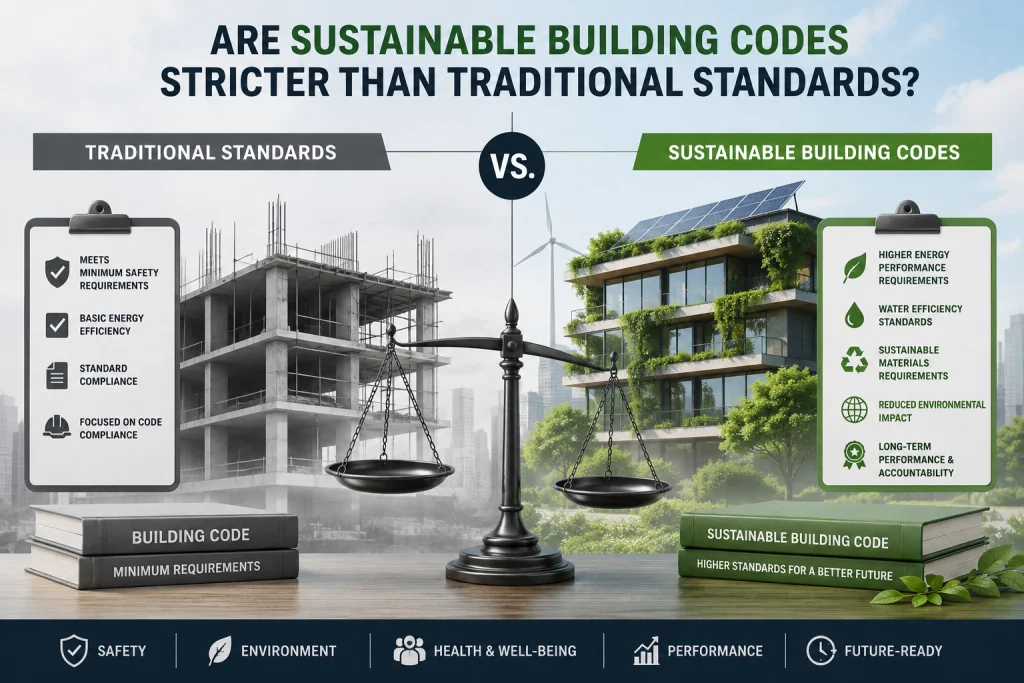
Traditional Building Codes (such as the International Building Code, or IBC) are primarily focused on life safety and structural integrity. They dictate fire resistance, structural load capacities, egress routes, and basic accessibility. Their goal is to ensure a building does not collapse, catch fire easily, or harm its occupants.
Sustainable Building Codes (such as the International Green Construction Code (IgCC), CALGREEN, or local "stretch" energy codes) focus on environmental performance and resource efficiency. They regulate Energy Use Intensity (EUI), water conservation, indoor environmental quality (IEQ), waste management, and increasingly, embodied carbon and building electrification.
So, Are They "Stricter"?
The short answer is yes, but not in the way you might think. Sustainable codes do not usually contradict traditional safety codes; rather, they build upon them. The "strictness" lies in three distinct areas:
1. Broader Scope and Complexity
Traditional codes tell you how to build a safe wall. Sustainable codes tell you what materials can go in that wall, how much energy the HVAC system behind it can use, and how to document the supply chain of the drywall. The sheer volume of metrics and performance thresholds makes sustainable codes inherently more complex.
2. Rigorous Documentation and Verification
In traditional construction, passing a visual inspection often suffices. Sustainable codes require rigorous proof of performance. This includes energy modeling, third-party commissioning, continuous air barrier testing, and detailed waste diversion tracking. The administrative burden and the strictness of the paperwork are significantly higher.
3. Forward-Looking Performance Thresholds
Traditional codes are largely reactive. Sustainable codes are proactive and constantly tightening. For example, many 2025 and 2026 municipal codes now mandate all-electric buildings (banning natural gas hookups) and require strict limits on embodied carbon. Meeting these aggressive, forward-looking targets requires a higher standard of engineering and execution.
Compliance and Regulatory Understanding: Navigating the Maze
The greatest risk in modern construction isn't just failing an inspection; it's misunderstanding the regulatory landscape. Because green building regulations are a patchwork of local, state, and federal mandates, compliance requires a strategic approach.
Here is how construction professionals can master regulatory understanding and ensure seamless compliance:
1. Distinguish Between "Code" and "Certification"
A common pitfall is confusing mandatory codes with voluntary certifications.
- Codes (Mandatory): The IgCC, local energy codes, and state green mandates (like California's Title 24) are the law. You cannot get a Certificate of Occupancy without meeting them.
- Certifications (Voluntary): LEED, BREEAM, WELL, and Living Building Challenge are third-party rating systems. While they are often "stricter" than code, they are usually adopted voluntarily for marketability, tax incentives, or corporate ESG goals.
- Actionable Insight: Always verify with the local Authority Having Jurisdiction (AHJ) exactly which codes are legally binding for your specific site.
2. Integrate Sustainability in Pre-Design
You cannot value-engineer your way to green code compliance at the end of a project. Because sustainable codes dictate everything from window-to-wall ratios to HVAC electrification, sustainability must be integrated during the pre-design and schematic phases. Bring your MEP engineers, energy modelers, and key subcontractors to the table before the design is locked in.
3. Invest in Specialized Training and Technology
The strictness of sustainable codes requires new skill sets. Project managers and superintendents need to understand building envelope commissioning, low-VOC material tracking, and advanced BIM (Building Information Modeling) for energy analysis. Investing in construction management software that tracks material sustainability and waste diversion in real-time can save you from costly compliance failures in the field.
4. Vet Your Subcontractors and Supply Chain
A general contractor is only as compliant as their lowest-performing subcontractor. If your framing sub doesn't understand the strict air-sealing requirements of the new energy code, the whole building will fail the blower door test. Ensure your subcontractors are trained in current green standards and require them to provide detailed Environmental Product Declarations (EPDs) for materials.
Are sustainable building codes stricter than traditional standards? Yes. They demand higher performance, require exhaustive documentation, and push the industry toward aggressive environmental targets like zero-carbon and all-electric operations.
However, viewing these codes merely as "stricter rules" is a mistake. They are an evolution of the construction standard. For forward-thinking construction firms, mastering compliance and regulatory understanding is not just about avoiding fines or delays—it is a competitive advantage. Firms that can seamlessly navigate the complexities of green codes will win more bids, attract top-tier clients, and future-proof their businesses in a rapidly changing regulatory world.
Found this article valuable?
Share it with fellow builders, architects, or download the QR code.
Written by Shanmugam2026
Verified CreatorARQONZ Editorial Team brings you expert insights, construction guides, and architectural design trends from across the building industry.
Related Articles in Construction
What Should I Never Say to My Contractor?