Can Construction Management Software Really Improve Efficiency?
Can Construction Management Software Really Improve Efficiency?
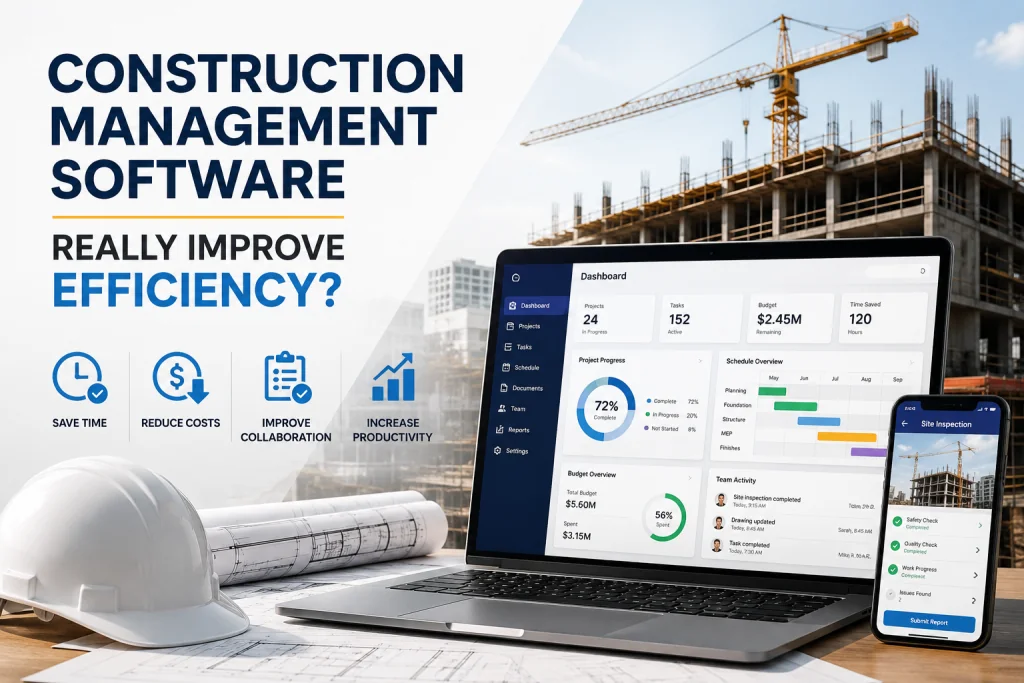
In the construction industry, margins are notoriously tight, and projects are famously complex. Between managing subcontractors, tracking change orders, and ensuring safety compliance, project managers and contractors are constantly juggling a million moving parts. For years, the industry relied on a patchwork of spreadsheets, paper blueprints, and endless email chains.
Today, Construction Management Software (CMS) is heralded as the ultimate cure for industry inefficiencies. But with high subscription costs and a steep learning curve, many construction leaders are asking a critical question: Can construction management software really improve efficiency, and is the investment actually worth it?
Let’s break down the realities of construction tech, evaluate the return on investment (ROI), and determine if it’s time to digitize your job site.
The Hidden Costs of "Doing Things the Old Way"
Before evaluating the solution, we have to look at the cost of the problem. Relying on legacy methods (paper, whiteboards, and disjointed spreadsheets) carries hidden costs that eat directly into your bottom line:
- Rework: Outdated blueprints in the field lead to building the wrong thing.
- Communication Silos: When the office and the field aren't on the same page, delays are inevitable.
- Lost Data: Misplaced daily logs, RFIs, and submittals result in unpaid change orders and disputed claims.
According to industry studies, construction professionals spend up to 30% of their time on non-value-added activities—like searching for project data or waiting for approvals. This is the exact inefficiency that CMS is designed to eliminate.
How Construction Management Software Drives Efficiency
When implemented correctly, construction management software transforms chaos into a streamlined workflow. Here is how it tangibly improves efficiency:
1. A Single Source of Truth
Gone are the days of version control issues. Cloud-based CMS platforms ensure that everyone—from the architect to the superintendent—is looking at the exact same set of drawings, schedules, and budgets in real-time.
2. Automated Workflows and Approvals
Software automates tedious administrative tasks. RFIs, submittals, and punch lists can be routed automatically to the right stakeholders. What used to take days of chasing down signatures via email can now be completed in minutes via a mobile app on the job site.
3. Real-Time Financial Tracking
Modern CMS integrates estimating, budgeting, and accounting. Project managers can see live cost-to-complete projections, track labor hours against budgets, and instantly spot financial leaks before they become catastrophic overruns.
4. Enhanced Field-to-Office Connectivity
With mobile capabilities, superintendents can log daily reports, capture safety incidents, and update schedules directly from their smartphones. This eliminates the "double-entry" of data and ensures the office has accurate, up-to-the-minute information.
Evaluating the Investment: Is It Worth It?
So, we know the software can improve efficiency. But does that translate to a positive ROI? To evaluate if the investment is worth it, we have to weigh the costs against the returns.
The Costs of Implementation
- Software Subscriptions: Licensing fees can range from a few hundred to several thousand dollars per month, depending on the scale and features.
- Training and Onboarding: Getting your team to adopt a new system takes time and resources.
- Integration: You may need to pay for IT support to integrate the CMS with your existing accounting or ERP software.
The Returns (The ROI)
- Reduced Rework: Catching clashes and errors in the preconstruction phase via digital model coordination saves tens of thousands of dollars per project.
- Faster Project Delivery: Streamlined communication and automated approvals keep the critical path moving, allowing you to take on more projects per year.
- Captured Revenue: By digitally tracking every change order and linking it to daily logs and photos, you eliminate "he-said-she-said" disputes, ensuring you get paid for every extra hour and material.
- Lower Insurance and Legal Costs: Meticulous digital documentation protects you against claims and can sometimes lower liability insurance premiums.
The Verdict
Yes, the investment is absolutely worth it—but with a major caveat.
The software itself is only as good as the people using it. If you purchase a top-tier CMS but your field staff refuses to use the mobile app, your ROI will be negative. The investment is worth it only if you treat the software rollout as a change management initiative, not just an IT purchase.
3 Tips to Ensure Your Software Investment Pays Off
If you decide to take the leap, follow these rules to guarantee a return on your investment:
- Involve the Field Team Early: Don’t buy software solely based on what the executive team wants. Involve superintendents and project engineers in the demo process. If the mobile app isn't intuitive for the guys in the field, it will fail.
- Start Small, Then Scale: Don’t try to implement every feature on day one. Start with core functions like document control and daily reporting. Once the team is comfortable, roll out scheduling, financials, and safety modules.
- Choose a Partner, Not Just a Product: Look for a software vendor that offers robust customer support, onboarding training, and continuous updates. You want a tech partner invested in your company's growth.
Can construction management software really improve efficiency? Absolutely. It eliminates data silos, automates busywork, and connects the field to the office in real-time.
Is it worth the investment? Yes, provided you choose the right platform and commit to proper team adoption. In an industry where a single miscommunication can cost thousands of dollars, the cost of software is a fraction of the cost of inefficiency
Found this article valuable?
Share it with fellow builders, architects, or download the QR code.
Written by Shanmugam2026
Verified CreatorARQONZ Editorial Team brings you expert insights, construction guides, and architectural design trends from across the building industry.
Related Articles in Construction

What Should I Never Say to My Contractor?