Can I Retrofit My Existing Home for Energy Efficiency?
Can I Retrofit My Existing Home for Energy Efficiency?
Practical solutions for current property owners
A Strategic Guide for Construction Professionals, Contractors, and Builders
If your inbox hasn’t been flooded with this question lately, it will be soon. As we move through mid-2026, shifting energy costs, stricter municipal building codes, and a growing demand for sustainable living have pushed energy efficiency to the top of every homeowner’s priority list.
Clients are no longer just asking about aesthetic remodels; they are asking, "Can I retrofit my existing home for energy efficiency?"
For the construction industry, the answer is a resounding yes. But more importantly, retrofitting represents one of the most lucrative and impactful growth opportunities for modern contracting firms. Today’s property owners need expert guidance to navigate the transition from drafty, energy-bleeding structures to high-performance homes.
Here is a professional breakdown of the practical solutions you can pitch, design, and execute for your clients, and how to position your firm as the go-to expert in deep energy retrofits.
The Shift: From New Builds to Deep Energy Retrofits (DER)
Historically, the highest energy performance was reserved for new construction. Today, advancements in building science and non-invasive technologies mean existing homes can achieve near-net-zero performance.
When advising property owners, it is crucial to frame retrofitting not as a massive, disruptive tear-down, but as a strategic, phased upgrade to the home's core systems. Here are the practical solutions you should be integrating into your proposals.
Practical Solutions to Pitch and Execute
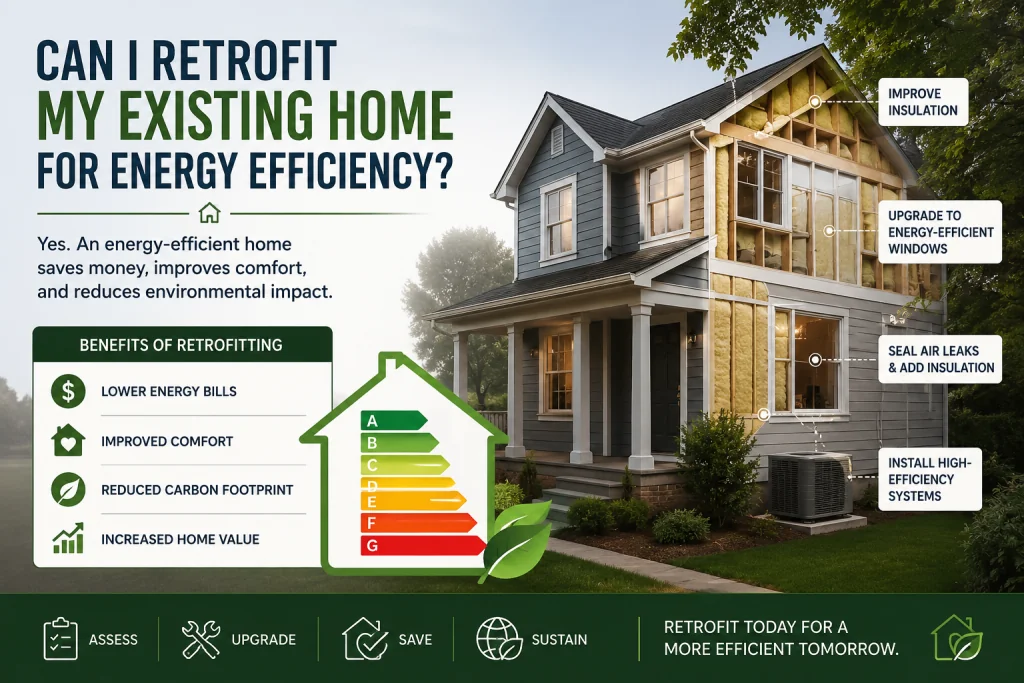
1. Fortifying the Building Envelope
The building envelope is the first line of defense. Homeowners often see the highest immediate ROI by stopping energy leaks before upgrading mechanical systems.
- Advanced Insulation: Move beyond standard fiberglass. Pitch dense-pack cellulose for existing wall cavities (injected from the exterior with minimal drywall damage) and closed-cell spray foam for attics and basements. In 2026, aerogel-infused insulation panels are also becoming a viable, space-saving option for historic homes where interior square footage cannot be sacrificed.
- Air Sealing & Thermal Bridging: Use blower door testing to identify leaks. Seal top plates, rim joists, and penetrations. Address thermal bridging by adding continuous exterior insulation (ci) during siding replacement projects.
- High-Performance Fenestration: Recommend triple-pane, argon-filled windows with low-E coatings. If full replacement is out of the client's budget, offer interior storm window inserts as a highly effective, lower-cost alternative.
2. Electrification and HVAC Upgrades
With the grid modernizing and fossil-fuel bans expanding in many municipalities, electrification is the future of home comfort.
- Cold-Climate Heat Pumps: Air-source and ground-source heat pumps have seen massive technological leaps. They are now highly efficient even in sub-zero temperatures. Pitching a ducted or ductless mini-split heat pump system is a prime way to replace aging gas furnaces.
- Ventilation (HRVs/ERVs): As you tighten the building envelope, you must address indoor air quality. Always pair air-sealing projects with the installation of Heat Recovery Ventilators (HRVs) or Energy Recovery Ventilators (ERVs) to ensure the home "breathes" efficiently.
- Heat Pump Water Heaters (HPWH): Swapping a standard electric or gas water heater for a hybrid HPWH is a relatively low-cost retrofit that yields massive energy savings and dehumidifies the surrounding space.
3. Smart Electrical and "Solar-Ready" Preparations
Energy efficiency isn't just about saving power; it's about managing it intelligently.
- Smart Panels & Wiring: Upgrade older electrical panels to smart panels that allow homeowners to monitor and circuit-level manage their energy usage.
- EV and Solar Pre-wiring: Even if the client isn't installing solar panels or an EV charger today, running the conduit and wiring during a retrofit saves them thousands in the future. Pitch this as "future-proofing" the property.
- Automated Lighting & Controls: Integrate LED lighting with smart sensors and daylight harvesting controls, especially in large remodels or additions.
How Construction Firms Can Streamline the Retrofit Process
Knowing the solutions is only half the battle. To win these bids and execute them profitably, construction professionals need to refine their project management approach.
1. Start with an Energy Audit and Modeling Don't guess; measure. Partner with certified energy auditors or invest in the software to run energy models (like REM/Rate or EnergyPlus). Showing a client a data-driven report that predicts their exact energy savings will instantly separate you from competitors who are just quoting "gut feelings."
2. Offer Phased "Roadmaps" A full deep energy retrofit can be a sticker shock for property owners. Instead of a single massive proposal, offer a 3-to-5-year "Energy Roadmap."
- Phase 1: Air sealing, attic insulation, and LED lighting (Low cost, high ROI).
- Phase 2: Window replacement and HVAC electrification (Medium cost, high comfort).
- Phase 3: Solar integration and exterior continuous insulation (High cost, long-term payoff). This approach keeps the client in your ecosystem for years.
3. Navigate the Rebate Landscape In 2026, federal, state, and local incentives for energy-efficient upgrades are more robust than ever. Many contractors lose bids because they present the gross cost. By acting as a consultant who helps the homeowner navigate tax credits, utility rebates, and green financing (like PACE or HERO loans), you transform from a mere contractor into an indispensable project partner.
When a property owner asks, "Can I retrofit my existing home for energy efficiency?" they are really asking, "Can you make my home more comfortable, lower my bills, and increase my property value without ruining my life?"
As construction professionals, our job is to say yes, and then deliver a meticulously planned, scientifically backed execution. By mastering building envelope science, electrification, and phased project delivery, your firm won't just be riding the green building trend—you will be defining the standard for the future of residential construction.
Found this article valuable?
Share it with fellow builders, architects, or download the QR code.
Written by Shanmugam2026
Verified CreatorARQONZ Editorial Team brings you expert insights, construction guides, and architectural design trends from across the building industry.
Related Articles in Construction

What Should I Never Say to My Contractor?