Does Green Construction Really Help the Environment?
Does Green Construction Really Help the Environment?
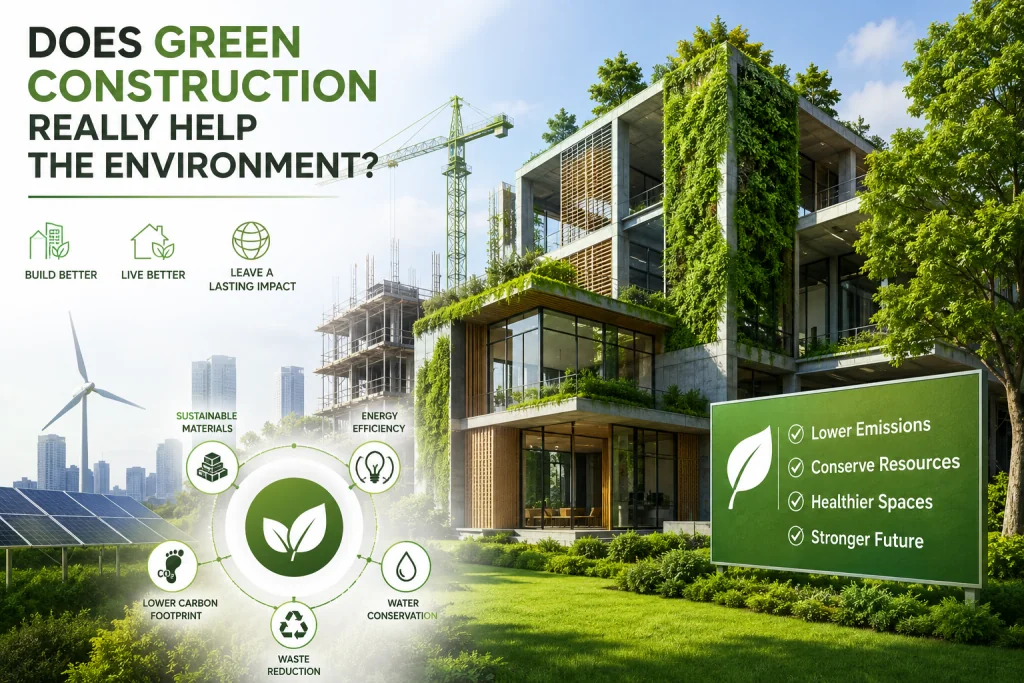
Subtitle: Separating industry buzzwords from measurable ecological and economic impact in 2026 and beyond.
The construction industry has long carried a heavy environmental footprint. Historically responsible for nearly 40% of global energy-related carbon dioxide emissions, the sector has been under a microscope for years. In response, "green construction" has evolved from a niche trend into a central pillar of modern project planning.
But as we navigate 2026—with stricter global net-zero targets looming and supply chains shifting toward sustainability—a critical question remains among developers, contractors, and investors: Does green construction really help the environment, or is it just an expensive marketing buzzword?
The short answer is an unequivocal yes. However, to understand the true value of sustainable building, industry professionals must look past the surface-level marketing and examine the data, the methodologies, and the long-term lifecycle impacts.
Here is a professional breakdown of how green construction is tangibly reshaping our environmental reality.
1. Tackling Both Operational and Embodied Carbon
To measure environmental impact accurately, the industry must look at two distinct metrics: operational carbon and embodied carbon.
- Operational Carbon: This is the energy used to heat, cool, and light a building over its lifespan. Green construction drastically reduces this through high-performance building envelopes, advanced HVAC systems, smart building management systems (BMS), and the integration of on-site renewables (like solar roofing).
- Embodied Carbon: This refers to the greenhouse gas emissions arising from the manufacturing, transportation, installation, and disposal of building materials. True green construction addresses this by specifying low-carbon concrete, mass timber, recycled steel, and locally sourced materials to minimize transportation emissions.
The Verdict: By attacking both carbon types, green buildings fundamentally alter the carbon trajectory of the built environment, moving us closer to true net-zero outcomes.
2. Revolutionizing Resource Management and Waste Reduction
Traditional construction is notoriously wasteful, with a significant percentage of materials ending up in landfills. Green construction flips this model through:
- Design for Deconstruction (DfD): Designing buildings so that materials can be easily dismantled and reused at the end of the building's life.
- Prefabrication and Modular Construction: Moving building processes to controlled factory environments drastically reduces material off-cuts and site waste.
- Circular Economy Integration: Sourcing reclaimed wood, recycled aggregates, and upcycled materials keeps resources in the supply chain and out of landfills.
The Verdict: Green construction transforms the job site from a linear waste generator into a node in a circular, resource-efficient economy.
3. Protecting Local Ecosystems and Water Tables
The environmental benefits of green construction extend beyond the building's footprint to the surrounding ecosystem. Sustainable site development focuses on:
- Water Conservation: Implementing low-flow fixtures, greywater recycling systems, and rainwater harvesting reduces the strain on municipal water supplies.
- Permeable Surfaces & Green Roofs: These features mitigate the urban heat island effect, reduce stormwater runoff, and prevent the contamination of local water tables with construction pollutants.
- Biodiversity Preservation: Careful site planning ensures that local flora and fauna habitats are protected or restored, rather than paved over.
The Verdict: Green buildings do not just occupy land; they actively integrate with and protect the local ecological infrastructure.
The Business Case: Why the Industry Must Care
While the environmental benefits are clear, construction professionals know that a project must also make financial sense to get built. Fortunately, the environmental and economic cases for green construction are deeply intertwined.
- Lifecycle Cost Savings: While the upfront capital expenditure (CapEx) for green technologies can be 2% to 5% higher, the operational expenditure (OpEx) savings are massive. Energy and water savings typically yield a return on investment (ROI) within 3 to 7 years.
- Future-Proofing Against Regulations: As municipal and federal governments enforce stricter environmental codes in 2026 and beyond, buildings constructed to green standards (like LEED, BREEAM, or WELL) avoid the risk of costly retrofits and regulatory fines.
- Market Demand and Asset Value: Tenants and buyers are increasingly demanding sustainable spaces. Green-certified buildings command higher lease rates, experience lower vacancy rates, and boast higher overall asset valuations.
Addressing the Skeptics: The "Greenwashing" Trap
The biggest threat to the green construction movement is "greenwashing"—the practice of making misleading or unsubstantiated claims about the environmental benefits of a product or project.
To ensure green construction really helps the environment, the industry must rely on rigorous, third-party verified data. This means utilizing Life Cycle Assessments (LCA) and Environmental Product Declarations (EPDs) to prove the sustainability of materials, rather than relying on vague marketing terms like "eco-friendly" or "natural.
Does green construction really help the environment? Absolutely. But it requires commitment. It requires architects to design with the lifecycle in mind, contractors to manage waste meticulously, and developers to prioritize long-term operational savings over short-term capital shortcuts.
As the construction industry continues to evolve, sustainability is no longer just an environmental imperative; it is a baseline requirement for business survival and success. The buildings we construct today will define the ecological and economic landscape of tomorrow. It is up to us to ensure they are built to last, and built to protect.
Found this article valuable?
Share it with fellow builders, architects, or download the QR code.
Written by Shanmugam2026
Verified CreatorARQONZ Editorial Team brings you expert insights, construction guides, and architectural design trends from across the building industry.
Related Articles in Construction

What Should I Never Say to My Contractor?