How Do I Know If Construction Noise Is Breaking the Law?
How Do I Know If Construction Noise Is Breaking the Law?
Construction is an inherently loud industry. From pile driving and jackhammering to the rumble of heavy diesel engines, noise is a byproduct of the job. However, there is a distinct line between "normal job site noise" and "legal liability."
Failing to manage construction noise can result in severe consequences: hefty municipal fines, work stoppages, OSHA citations, and damaged relationships with the surrounding community.
But with a complex web of federal, state, and local regulations, how do you know if your site’s noise levels are crossing the line? Here is a comprehensive guide to understanding legal noise limits and standards in the construction industry, and how to ensure your projects stay compliant.
The Two Pillars of Construction Noise Law
To understand if you are breaking the law, you first need to understand that "the law" regarding construction noise is divided into two distinct categories:
- Occupational Health and Safety: Regulations designed to protect your workers from hearing loss.
- Environmental and Community Standards: Regulations designed to protect the public from noise pollution and nuisance.
You must comply with both. Let’s break down the legal noise limits and standards for each.
1. Worker Safety: Occupational Noise Limits (OSHA Standards)
In the United States, the Occupational Safety and Health Administration (OSHA) sets the legal limits for noise exposure on the job site. These standards are based on a worker's Time-Weighted Average (TWA)—the average noise exposure over a standard 8-hour workday.
The Legal Limits for Workers:
- The Action Level (85 dBA): If a worker’s 8-hour TWA reaches 85 decibels (A-weighted), you have hit the "Action Level." At this point, you are legally required to implement a Hearing Conservation Program, which includes annual hearing tests, providing hearing protection, and training.
- The Permissible Exposure Limit (PEL) (90 dBA): If a worker’s 8-hour TWA reaches 90 dBA, you are breaking the law. OSHA’s legal limit for noise exposure is 90 dBA. If levels exceed this, you must implement administrative or engineering controls to reduce the noise. If those fail, hearing protection is mandatory to bring exposure below the PEL.
Note: OSHA uses a 5-decibel exchange rate. This means for every 5 dB increase in noise, the legal permissible exposure time is cut in half (e.g., 95 dBA is only legal for 4 hours; 100 dBA is only legal for 2 hours).
2. The Community: Environmental Noise Limits and Standards
While OSHA protects your crew, local and state governments protect the public. Unlike federal workplace laws, there is no single national standard for community construction noise. Instead, legal noise limits and standards for the public are dictated by local municipal codes and city ordinances.
However, most local jurisdictions follow guidelines set by the Environmental Protection Agency (EPA) or the World Health Organization (WHO). Here is how community noise laws are typically structured:
A. Property Line Decibel Limits
Cities usually set maximum allowable noise levels measured at the "property line" or at the nearest "sensitive receptor" (e.g., a nearby home, hospital, or school).
- Residential Zones: Typically limited to 55 to 65 dBA during the day, and 45 to 55 dBA at night.
- Commercial/Industrial Zones: Usually allow higher limits, often between 65 to 75 dBA.
- Measurement scale: Community noise is often measured in dBC (which captures low-frequency rumbles from heavy machinery better than dBA) or Leq (Equivalent Continuous Sound Level).
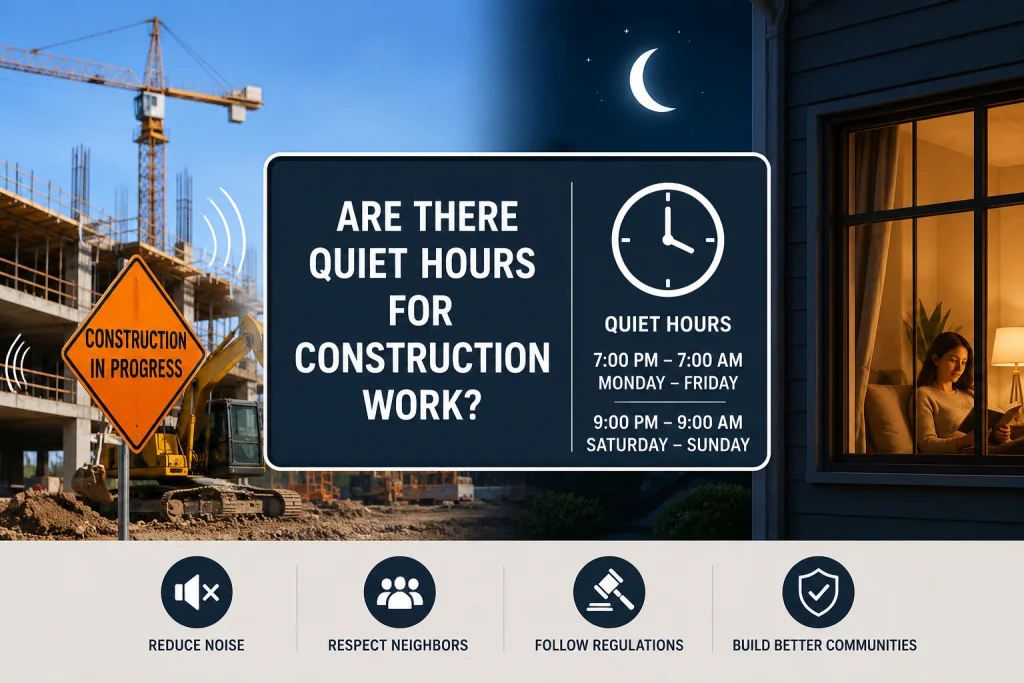
B. Time-of-Day Restrictions ("Quiet Hours")
Almost all municipalities enforce strict time-of-day limits. Standard legal working hours are typically:
- Monday – Friday: 7:00 AM to 6:00 PM (or 7:00 PM)
- Saturday: 8:00 AM to 5:00 PM
- Sunday & Federal Holidays: Prohibited, or strictly limited to very quiet work.
C. Nuisance Ordinances
Even if you are technically under the decibel limit, many cities have "plainly audible" or "nuisance" laws. If a neighbor can hear your construction from their bedroom with the windows closed, you may be cited for creating a public nuisance, regardless of what the sound meter says.
How to Measure and Prove Compliance
You cannot manage what you do not measure. Relying on the "naked ear" is a fast track to a citation. To prove you are meeting legal noise limits and standards, you need the right tools:
- For Workers (Personal Dosimeters): Have safety managers wear personal noise dosimeters throughout the shift. These clip onto the worker's collar and calculate their exact 8-hour TWA exposure.
- For the Community (Boundary Sound Level Meters): Install calibrated, weatherproof Sound Level Meters (SLMs) at the site boundary. Modern systems connect to the cloud, providing real-time data logging. If a neighbor complains, you can pull the historical data to prove you were within legal limits at the time of the complaint.
Pro Tip: Always ensure your equipment is calibrated annually by a certified acoustician. Uncalibrated data will not hold up in a legal dispute.
Proactive Mitigation: Keeping Noise in the Legal Zone
If your monitoring shows you are approaching or exceeding legal noise limits and standards, you must take immediate action to mitigate the sound.
- Equipment Maintenance: A poorly maintained excavator with a broken muffler or a dull saw blade can generate up to 10 dBA more noise than a well-maintained one. Enforce strict preventative maintenance.
- Acoustic Barriers: Deploy temporary acoustic fencing, sound blankets, and plywood hoardings around the perimeter of the site to block and absorb sound waves.
- Strategic Scheduling: Schedule the noisiest activities (pile driving, concrete breaking, demolition) for the middle of the day when ambient city noise is highest and community sensitivity is lowest.
- Alternative Methods: Swap out pneumatic jackhammers for hydraulic splitters, or use silent crushers instead of impact breakers where feasible.
Knowing if construction noise is breaking the law requires a dual approach: monitoring your crew's exposure against OSHA’s Permissible Exposure Limits, and tracking boundary noise against local municipal ordinances.
Because local environmental laws vary wildly from city to city, the most important step any construction manager can take is to read the specific noise ordinance of the municipality they are building in.
Found this article valuable?
Share it with fellow builders, architects, or download the QR code.
Written by Shanmugam2026
Verified CreatorARQONZ Editorial Team brings you expert insights, construction guides, and architectural design trends from across the building industry.
Related Articles in Construction

What Should I Never Say to My Contractor?