How Does Indoor Air Quality Improve With Green Building?
How Does Indoor Air Quality Improve With Green Building?
For decades, the construction industry’s primary metrics for success were structural integrity, cost-efficiency, and energy conservation. However, as we move deeper into the 2020s, a critical paradigm shift has occurred. Today’s developers, architects, and contractors recognize that a building’s most valuable asset is not its concrete and steel, but the people inside it.
With occupants spending roughly 90% of their time indoors, Indoor Air Quality (IAQ) has emerged as a cornerstone of modern building design. But how exactly does green building improve IAQ, and what are the resulting health and wellness benefits?
For construction professionals, understanding this connection is no longer just a matter of environmental responsibility—it is a critical business imperative.
The Mechanics: How Green Building Engineering Drives IAQ
Green building is often mistakenly viewed solely through the lens of solar panels and water conservation. In reality, true green building—guided by frameworks like LEED, BREEAM, and the WELL Building Standard—integrates IAQ into the very DNA of the structure. Here is how green construction practices directly elevate air quality:
1. Source Control Through Material Selection
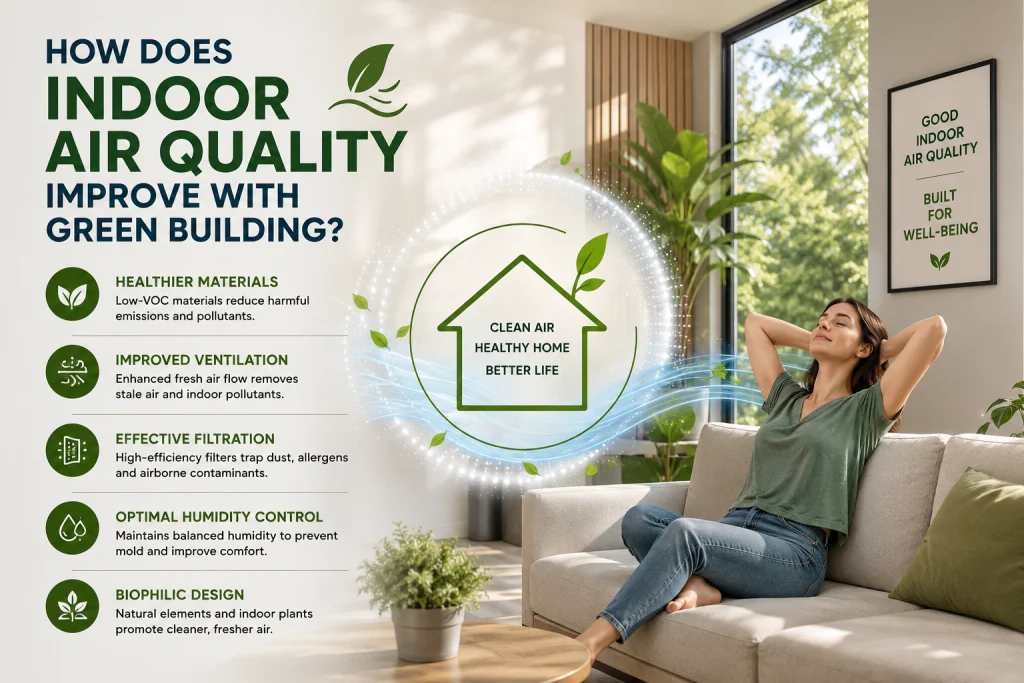
The most effective way to manage indoor air is to prevent pollutants from entering it in the first place. Green building mandates the use of low-VOC (Volatile Organic Compound) paints, adhesives, sealants, and composite woods. By specifying these materials, builders eliminate the "off-gassing" of toxic chemicals like formaldehyde and benzene, which are primary culprits in poor indoor air.
2. Advanced Ventilation and Filtration Systems
Traditional HVAC systems often recirculate stale air to save energy. Green buildings utilize Demand-Controlled Ventilation (DCV) equipped with CO2 sensors to dynamically adjust fresh air intake based on real-time occupancy. Furthermore, green standards require high-efficiency filtration (MERV 13 to HEPA) that captures fine particulate matter (PM2.5), allergens, and airborne pathogens before they are distributed throughout the space.
3. Moisture Management and the Building Envelope
Poor IAQ is frequently the result of hidden moisture leading to mold and mildew. Green building emphasizes a tightly sealed, highly insulated building envelope combined with strategic vapor barriers. By controlling humidity levels and preventing condensation within wall cavities, builders从根本上 (fundamentally) eliminate the biological pollutants that cause severe respiratory issues.
The Biological Impact: Tangible Health Benefits
When construction teams implement these green strategies, the biological benefits to the building's occupants are profound. Improved IAQ directly translates to a healthier population.
- Reduction in Respiratory Issues: By filtering out particulate matter and eliminating mold spores, green buildings drastically reduce the incidence of asthma, allergies, and other respiratory ailments. This is particularly critical in healthcare, educational, and senior living facilities.
- Mitigation of "Sick Building Syndrome" (SBS): SBS is a cluster of non-specific symptoms (headaches, eye irritation, fatigue) linked to time spent in a specific building. By removing chemical off-gassing and ensuring adequate fresh air, green buildings effectively eliminate the environmental triggers of SBS.
- Lowered Transmission of Airborne Pathogens: In a post-pandemic world, the health benefits of advanced filtration and increased outdoor air exchange rates cannot be overstated. Green HVAC designs dilute and remove airborne viruses, creating a biologically safer environment.
The Human Element: Wellness, Cognitive Function, and Productivity
Beyond the absence of illness, green buildings actively promote holistic wellness. The health benefits of superior IAQ extend directly into cognitive performance and overall well-being, offering massive value to commercial tenants and corporate occupants.
Enhanced Cognitive Function and Focus
Studies, including those from Harvard’s T.H. Chan School of Public Health, have shown that doubling ventilation rates and lowering VOC levels can improve cognitive function scores by over 60%. For office buildings, this means sharper decision-making, better crisis response, and higher quality work from employees.
Improved Sleep and Circadian Health
Wellness-focused green buildings often integrate IAQ with circadian lighting and thermal comfort controls. In residential and hospitality construction, ensuring high oxygen levels and optimal humidity in sleeping quarters leads to deeper, more restorative sleep, which is the foundation of long-term human wellness.
Reduced Absenteeism and Higher Retention
For corporate tenants, the wellness aspects of a green building directly impact the bottom line. Better air quality means fewer sick days. Furthermore, companies are increasingly using the "health and wellness" credentials of their office space as a tool to attract and retain top talent in a competitive labor market.
The Builder’s Perspective: The ROI of Healthy Buildings
For the construction industry, the question is often: How do we justify the upfront costs of these green IAQ strategies to our clients? The answer lies in the lifecycle ROI.
- Higher Property Valuations and Rental Premiums: Buildings certified for health and wellness command higher lease rates and experience lower vacancy rates. Tenants are willing to pay a premium for spaces that protect their employees' health.
- Future-Proofing Against Regulations: As municipal and national building codes increasingly adopt stringent IAQ and energy standards (such as updated ASHRAE guidelines), building green today prevents costly retrofits tomorrow.
- Reduced Liability and Warranty Claims: By utilizing moisture-managed envelopes and non-toxic materials, contractors reduce the long-term liability associated with mold remediation and material failures.
So, how does indoor air quality improve with green building? It improves through a holistic, science-backed approach that prioritizes source control, advanced ventilation, and meticulous moisture management.
The health benefits—ranging from reduced respiratory issues to enhanced cognitive function—prove that green building is fundamentally about human wellness. For the construction industry, embracing these practices is no longer just an environmental choice; it is a strategic advantage
Found this article valuable?
Share it with fellow builders, architects, or download the QR code.
Written by Shanmugam2026
Verified CreatorARQONZ Editorial Team brings you expert insights, construction guides, and architectural design trends from across the building industry.
Related Articles in Construction

What Should I Never Say to My Contractor?