How Loud Is Construction Noise and Is It Legal?
How Loud Is Construction Noise and Is It Legal?
Meta Description: Discover how loud construction noise really is, whether it’s legal, and how to navigate noise level standards and compliance to protect your workers and your project.
If you have ever managed a construction site in or near a populated area, you know that noise is one of the most common sources of friction with the local community. From the rhythmic pounding of pile drivers to the high-pitched whine of concrete saws, construction is inherently loud.
But as a construction professional, you need to know: Just how loud is it? Is it actually legal? And how do you ensure your site remains in compliance with local and federal standards?
In this guide, we will break down the reality of construction noise, the legal frameworks surrounding it, and actionable strategies to keep your site compliant and your neighbors satisfied.
How Loud Is Construction Noise? (The Decibel Reality)
To understand construction noise, we have to look at the decibel (dB) scale. The decibel scale is logarithmic, meaning an increase of just 3 dB actually doubles the acoustic energy and the perceived loudness.
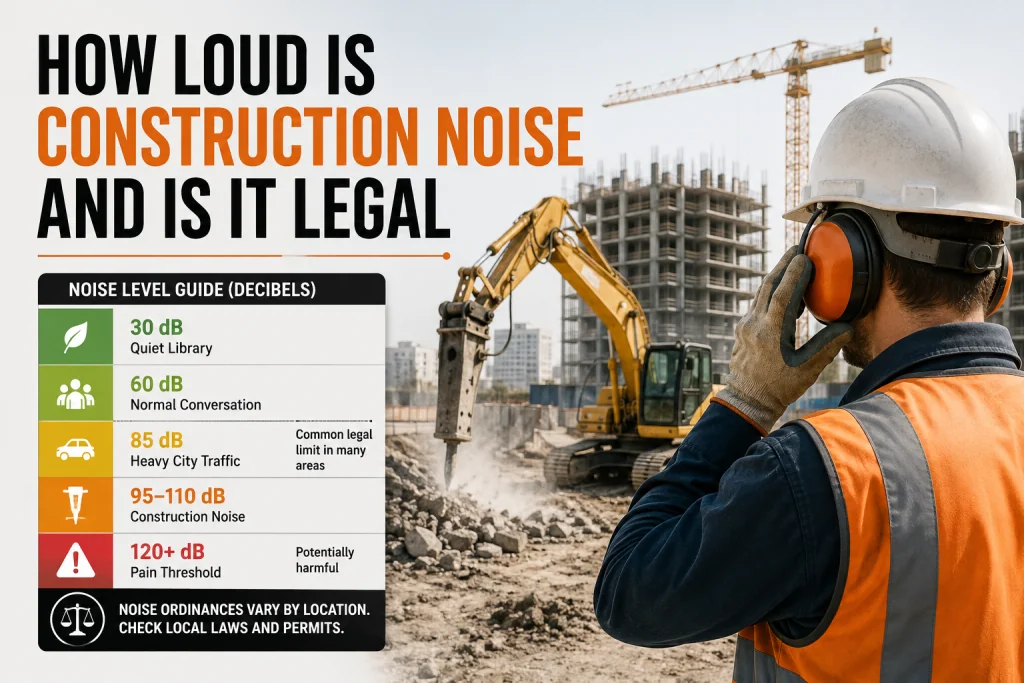
For context, normal conversation is about 60 dB. Here is how common construction equipment stacks up:
- Heavy Bulldozer / Excavator: 80 – 95 dB
- Circular Saw / Concrete Saw: 90 – 105 dB
- Jackhammer / Pneumatic Drill: 100 – 115 dB
- Backup Alarms: 97 – 112 dB
- Pile Driving: 100 – 120+ dB
When multiple pieces of equipment are running simultaneously, the cumulative noise on a job site can easily exceed 100 dB. To put that in perspective, prolonged exposure to noise above 85 dB can cause permanent hearing damage, and 120 dB is the threshold of pain.
Is Construction Noise Legal?
The short answer is yes, but with strict conditions.
There is no federal law that outright bans construction noise. However, the "right to build" is constantly balanced against the public’s "right to quiet enjoyment" of their property. Therefore, construction noise is legal only when it adheres to a complex web of local, state, and federal regulations.
Legality usually hinges on three main factors:
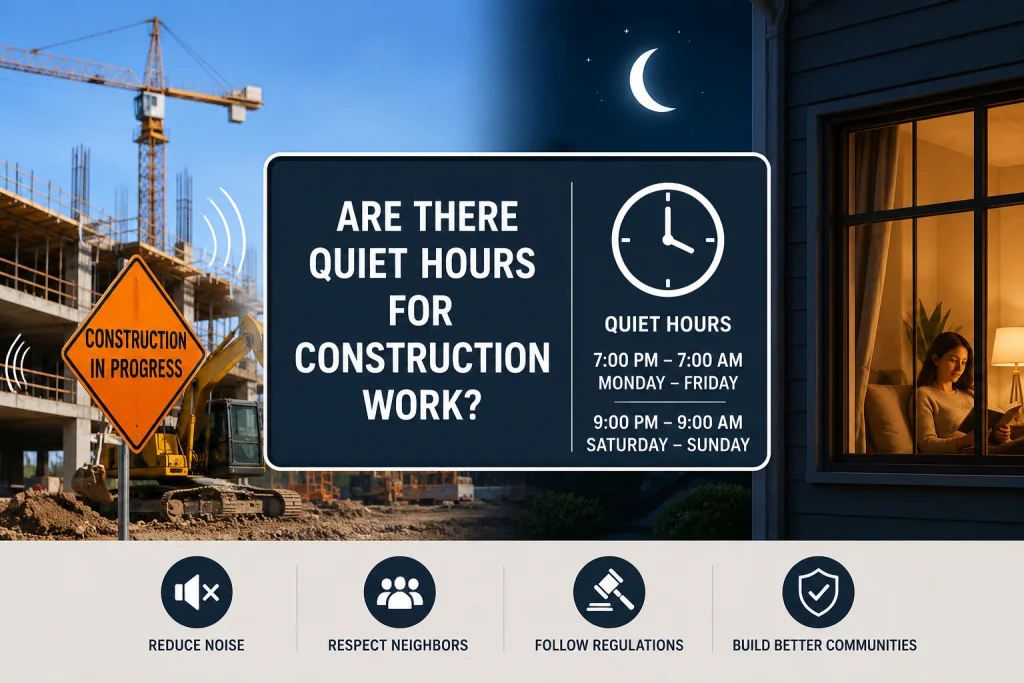
- Time of Day: Most municipalities restrict construction to specific hours (typically 7:00 AM to 6:00 PM on weekdays, with even stricter limits on weekends). Nighttime construction is usually illegal unless a special variance is granted.
- Zoning and Location: Noise limits are much stricter when a site borders residential zones, hospitals, or schools compared to commercial or industrial zones.
- Duration and Frequency: A short burst of loud noise (like a truck backing up) is treated differently by the law than a continuous, droning hum (like a generator).
Noise Level Standards and Compliance
When discussing compliance in construction, you are actually dealing with two entirely different regulatory frameworks: Worker Safety and Community Impact.
1. Worker Safety Compliance (OSHA)
The Occupational Safety and Health Administration (OSHA) regulates noise to protect the hearing of your crew.
- The Action Level: 85 dBA (decibels weighted for human hearing) averaged over an 8-hour workday. If noise hits this level, you must implement a hearing conservation program.
- The Permissible Exposure Limit (PEL): 90 dBA averaged over 8 hours. If noise exceeds this, you must provide and enforce the use of hearing protection.
- Note: For every 5 dB increase above 90 dBA, the permissible exposure time is cut in half (e.g., at 100 dBA, workers can only be exposed for 2 hours without protection).
2. Community Impact Compliance (EPA and Local Ordinances)
While OSHA protects your workers, the Environmental Protection Agency (EPA) and local city councils protect the public.
- Local noise ordinances typically measure noise at the property line or the nearest sensitive receptor (like a neighbor's bedroom window).
- Typical Limits: Many cities set daytime limits between 55 dBA and 75 dBA at the property line, and nighttime limits between 45 dBA and 55 dBA.
- Measurement Metrics: Compliance is rarely measured by a single "peak" noise event. Inspectors usually look at the Leq (Equivalent Continuous Sound Level), which calculates the average noise energy over a specific period (usually 1 hour or 8 hours).
4 Strategies for Construction Noise Compliance
Fines for noise violations can halt your project and damage your company’s reputation. Here is how proactive construction managers can ensure compliance:
1. Implement a Noise Monitoring Program
Don't wait for a neighbor to call the city. Install real-time, solar-powered noise monitors at the perimeter of your site. These devices track decibel levels 24/7 and send alerts to your phone if the noise approaches the legal limit. This data is also your best defense against false noise complaints.
2. Utilize Acoustic Barriers and Enclosures
Physical barriers are highly effective.
- Erect temporary acoustic fencing or sound blankets around the perimeter of the site, especially near property lines.
- Fit stationary, noisy equipment (like generators and compressors) with acoustic enclosures or "quiet" baffles.
3. Optimize Site Logistics and Equipment
How you run the site matters just as much as what you use.
- Location: Stage noisy activities as far away from residential property lines and sensitive receptors as possible.
- Equipment: Use newer, well-maintained equipment. A poorly maintained machine with a broken muffler can be significantly louder than a new one.
- Alternatives: Where possible, use hydraulic tools instead of pneumatic ones, and use broadband (white noise) backup alarms instead of traditional high-pitched "beepers," which cut through background noise much more aggressively.
4. Communicate with the Community
Never underestimate the power of goodwill. If you know a particularly noisy phase of construction is coming (like demolition or pile driving), notify the neighbors in advance. Put up signs with a direct contact number for the site superintendent. When people feel informed and heard, they are far less likely to call code enforcement over a minor infraction.
Construction noise is a byproduct of progress, but it is not an excuse for negligence. Understanding exactly how loud your site is, knowing the legal limits of your municipality, and actively managing both worker safety and community impact are critical components of modern construction management.
By treating noise mitigation as a core part of your site logistics plan, you protect your workers' health, avoid costly work stoppages, and build a reputation as a responsible, community-minded contractor.
Found this article valuable?
Share it with fellow builders, architects, or download the QR code.
Written by Shanmugam2026
Verified CreatorARQONZ Editorial Team brings you expert insights, construction guides, and architectural design trends from across the building industry.
Related Articles in Construction
What Should I Never Say to My Contractor?