Should I Prioritize Green Features or Budget-Friendly Options?
Should I Prioritize Green Features or Budget-Friendly Options?
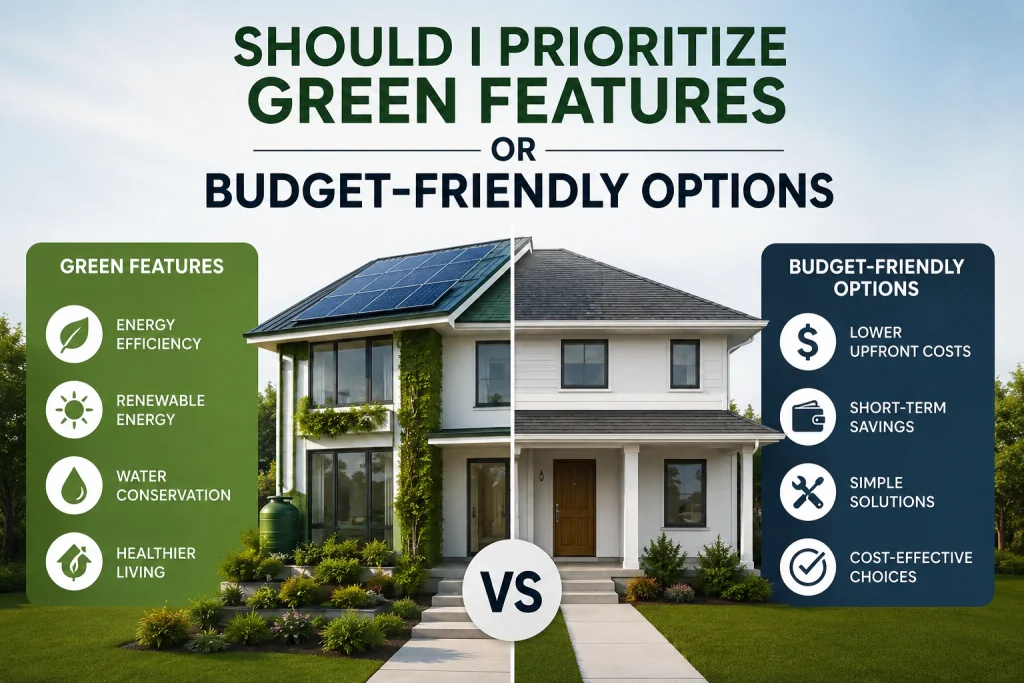
In the modern construction and real estate development industry, project leaders and investors are frequently caught in a classic tug-of-war: Should I prioritize green features or budget-friendly options?
On one hand, sustainable building practices, energy-efficient systems, and eco-friendly materials promise long-term operational savings, regulatory compliance, and premium market positioning. On the other hand, budget-friendly, traditional construction methods protect immediate cash flow, lower upfront Capital Expenditure (CapEx), and offer faster initial returns in tight-margin environments.
For construction investors, developers, and project managers, this is no longer a binary choice. Relying purely on upfront costs can lead to "stranded assets," while over-investing in green tech without market justification can kill a project’s financial viability.
To navigate this complexity, you need a structured approach. Here is a professional decision-making framework to help you evaluate and balance green investments versus budget-friendly options in your next construction project.
Understanding the Core Trade-Offs
Before applying the framework, it is crucial to understand the fundamental differences between the two approaches:
- Budget-Friendly Options: Focus on minimizing initial CapEx. They utilize conventional materials, standard HVAC systems, and traditional building envelopes. The risk: Higher Operational Expenditure (OpEx), vulnerability to future carbon taxes, and lower appeal to ESG-focused tenants.
- Green Features: Focus on minimizing lifecycle costs and environmental impact. They include high-performance insulation, solar-ready roofing, smart building management systems (BMS), and low-carbon materials. The risk: Higher upfront costs, longer initial payback periods, and potential supply chain complexities for specialized materials.
The 4-Step Decision-Making Framework for Construction Investments
To determine the right balance for your specific project, run your investment strategy through this four-step framework.
Step 1: Conduct a Rigorous Lifecycle Cost Analysis (LCCA)
The most common mistake in construction investment is evaluating costs solely at the groundbreaking phase. You must shift your perspective from initial construction costs to total lifecycle costs.
- Action: Model the CapEx vs. OpEx over a 10-, 20-, and 30-year horizon.
- Application: A budget-friendly standard HVAC system might save $50,000 on day one. However, a high-efficiency green alternative might save $15,000 annually in energy costs. If the payback period for the green system is under 5 years, the "budget-friendly" option is actually the more expensive long-term investment.
- Rule of Thumb: If a green feature’s lifecycle ROI outpaces the cost of capital (interest rates on construction loans), prioritize the green feature.
Step 2: Evaluate Market and Tenant Alignment
Sustainability is a premium, but only if the market is willing to pay for it. Your investment must align with the end-user’s demands and the local market’s absorption rate.
- Action: Analyze the target demographic and local commercial/residential trends.
- Application: If you are developing Class-A office space in a major metro area, corporate tenants with strict ESG (Environmental, Social, and Governance) mandates will demand LEED or BREEAM-certified spaces. In this scenario, green features are not optional; they are required to secure leases and command premium rents. Conversely, if you are building budget-friendly workforce housing in a highly price-sensitive market, prioritizing basic, cost-effective materials over expensive green tech will yield a higher immediate ROI.
Step 3: Forecast Regulatory and Incentive Landscapes
The construction industry is heavily influenced by local and national building codes, which are rapidly evolving toward net-zero standards.
- Action: Audit current and proposed municipal building codes, carbon taxes, and available green incentives.
- Application: Building to a "budget-friendly" minimum code today might result in costly retrofitting tomorrow if local emissions laws tighten. Furthermore, factor in the financial impact of green incentives. Many local governments and utility companies offer significant tax abatements, grants, or density bonuses for incorporating specific green features (like solar arrays or greywater systems). These incentives can artificially lower the CapEx of green features, making them highly competitive with budget options.
Step 4: Assess Risk Mitigation and Future-Proofing
Investments are ultimately about risk management. Green features often act as an insurance policy against future market and environmental shocks.
- Action: Evaluate the project’s vulnerability to climate risks, energy price volatility, and supply chain disruptions.
- Application: A budget-friendly building with a standard envelope will suffer higher cooling costs and tenant discomfort during extreme heat waves, leading to higher vacancy rates. Conversely, a building designed with passive green cooling and high thermal efficiency mitigates this operational risk. Furthermore, as the grid becomes more decentralized, buildings with green energy generation capabilities are insulated against rising utility costs.
Finding the Sweet Spot: Strategic Value Engineering
The goal of this framework is not to force you into an "all-green" or "all-budget" extreme. The most successful construction investors use Strategic Value Engineering to find the sweet spot.
This means applying budget-friendly options to areas of the building that do not impact long-term performance (e.g., standard finishes in back-of-house areas), while heavily prioritizing green features in high-impact areas (e.g., the building envelope, roofing, and primary mechanical systems).
Quick Wins for the Hybrid Approach:
- Passive Design First: Orient the building to maximize natural light and minimize solar heat gain. This costs almost nothing in extra CapEx but drastically reduces the budget required for mechanical HVAC systems.
- Electrification Readiness: Even if you cannot afford a full solar array today, budget-friendly conduit and panel sizing for future solar/battery installation future-proofs the asset for minimal upfront cost.
- Smart Controls: Investing in a smart Building Management System (BMS) is relatively low-cost compared to structural changes, but provides massive OpEx savings and data-driven green metrics.
When asking, "Should I prioritize green features or budget-friendly options?" the answer is: Prioritize data.
By utilizing a decision-making framework rooted in Lifecycle Cost Analysis, market alignment, regulatory forecasting, and risk mitigation, you remove the emotion from the equation. In today’s construction landscape, the most budget-friendly option is rarely the cheapest one on the invoice—it is the one that delivers the highest risk-adjusted return over the entire lifespan of the asset.
Found this article valuable?
Share it with fellow builders, architects, or download the QR code.
Written by Shanmugam2026
Verified CreatorARQONZ Editorial Team brings you expert insights, construction guides, and architectural design trends from across the building industry.
Related Articles in Construction
What Should I Never Say to My Contractor?