What Are the Biggest Green Construction Mistakes to Avoid?
What Are the Biggest Green Construction Mistakes to Avoid?
The construction industry has undergone a massive paradigm shift over the last decade. Sustainable building is no longer a niche marketing tactic; it is a baseline expectation driven by stringent environmental regulations, corporate ESG (Environmental, Social, and Governance) goals, and the undeniable demand for energy-efficient assets.
However, as the rush to build "green" accelerates, so does the learning curve. In the complex ecosystem of modern construction, good intentions do not always translate to high-performing buildings.
To help your team navigate this landscape, we are breaking down the biggest green construction mistakes to avoid. By learning from these common pitfalls, you can protect your profit margins, ensure regulatory compliance, and deliver buildings that actually perform as promised.
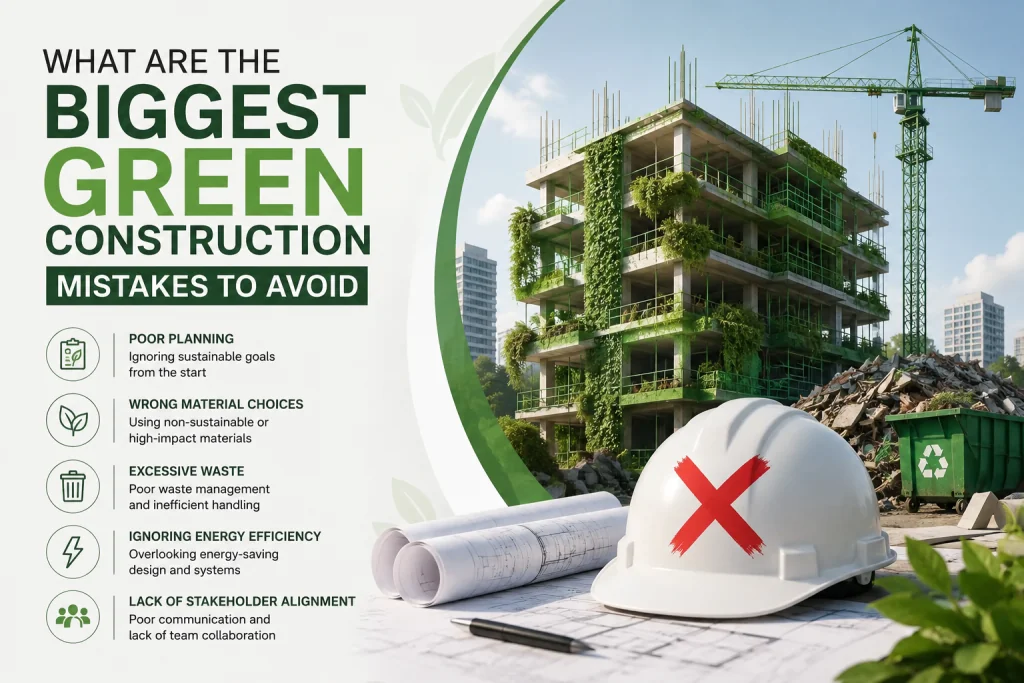
Pitfall 1: Treating Sustainability as an "Add-On"
The Mistake: Many project teams treat green building as a checklist of features to be tacked onto the design at the end of the process. They design a conventional building and then ask, "Where can we fit the solar panels and the green roof?"
The Reality: True sustainability requires Integrated Project Delivery (IPD). If the building envelope isn't optimized for passive heating and cooling before the HVAC systems are sized, you end up over-engineering (and over-spending on) mechanical systems.
The Fix: Bring the sustainability consultant, MEP engineers, and key subcontractors to the table during the pre-construction and conceptual design phases. Holistic design must happen before the first line is drawn.
Pitfall 2: Chasing the Plaque Over Actual Performance
The Mistake: Focusing entirely on achieving a specific certification (like LEED, BREEAM, or WELL) for marketing purposes, resulting in a massive "performance gap." The building earns the certificate on paper, but operates inefficiently in reality.
The Reality: Certification models are predictive; they are not guarantees. A common pitfall is designing for the certification metrics while ignoring the actual behavioral and operational realities of the end-users.
The Fix: Shift your focus from predictive modeling to outcome-based design. Utilize advanced energy modeling early on, and mandate rigorous Measurement and Verification (M&V) post-occupancy. Ensure the building’s actual energy and water use aligns with the design intent.
Pitfall 3: Ignoring Embodied Carbon in Favor of Operational Carbon
The Mistake: Specifying materials that look great on a lifecycle energy model but have a massive hidden carbon footprint. For example, importing "eco-friendly" materials from across the globe, or over-specifying concrete and steel without considering low-carbon alternatives.
The Reality: As buildings become more operationally efficient, embodied carbon (the greenhouse gas emissions arising from the manufacturing, transport, installation, and maintenance of building materials) now accounts for nearly half of a new building's total carbon footprint over its lifecycle.
The Fix: Conduct a whole-building Life Cycle Assessment (LCA) during the design phase. Specify low-carbon concrete, mass timber, or recycled steel, and prioritize locally sourced materials to slash transportation emissions.
Pitfall 4: "Value Engineering" the Green Out of the Project
The Mistake: When the budget tightens, the first items cut are often the sustainable features. High-efficiency glazing is swapped for standard glass; advanced building automation systems are downgraded; and submittals for sustainable materials are rejected in favor of cheaper, conventional alternatives.
The Reality: This is a false economy. Cutting green features to save on upfront capital expenditure (CapEx) almost always results in higher operational expenditure (OpEx), lower asset valuation, and missed ESG targets.
The Fix: Reframe "Value Engineering" as Value Enhancement. Use lifecycle cost analysis (LCCA) to show stakeholders the long-term ROI of sustainable features. If budget cuts are absolutely necessary, cut aesthetic finishes before cutting core energy and water-saving systems.
Pitfall 5: The "Handover Handoff" (Neglecting Commissioning)
The Mistake: The construction team builds a highly complex, technologically advanced green building, hands over the keys to the facility management (FM) team, and walks away. Six months later, the building is consuming 30% more energy than modeled.
The Reality: A green building is only as good as the people operating it. If the FM team doesn't understand the Building Management System (BMS), or if the systems were never properly calibrated, the building will fail to perform.
The Fix: Implement a robust, multi-phase Commissioning (Cx) process. Don't stop at functional performance testing. Include enhanced commissioning that extends 10 to 12 months post-occupancy. Crucially, invest heavily in training the facility managers and building operators so they can optimize the systems in real-time.
Green construction is not just about using the right materials or installing the right technology; it is about a fundamental shift in how we manage the construction process.
By avoiding the pitfalls of siloed design, superficial certifications, ignored embodied carbon, short-sighted value engineering, and poor handovers, construction leaders can mitigate risk and deliver true value.
Sustainability in construction is a marathon, not a sprint. Learn from the mistakes of the past, integrate your teams early, and focus on long-term performance. The result will be buildings that are not just green on paper, but profitable, resilient, and future-proof in reality.
Found this article valuable?
Share it with fellow builders, architects, or download the QR code.
Written by Shanmugam2026
Verified CreatorARQONZ Editorial Team brings you expert insights, construction guides, and architectural design trends from across the building industry.
Related Articles in Construction
What Should I Never Say to My Contractor?