What Should Be in a Contractor Agreement to Protect You From Surprise Costs?
What Should Be in a Contractor Agreement to Protect You From Surprise Costs?
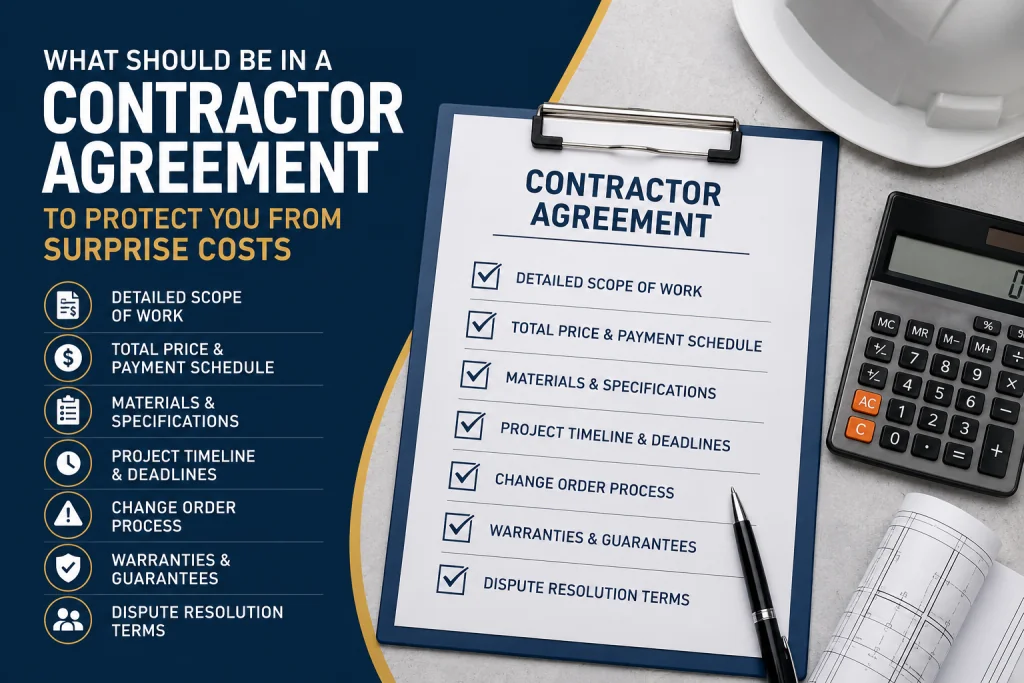
In the construction industry, few things derail a project faster than the dreaded "surprise cost." Whether you are a project owner footing the bill or a general contractor trying to maintain profit margins, unexpected financial hits can strain relationships, halt progress, and lead to costly disputes.
The secret to avoiding these financial landmines doesn’t lie in crystal balls; it lies in the contract. A well-drafted contractor agreement is your best defense against budget blowouts.
Here is a comprehensive guide on what must be included in your contractor agreements—specifically focusing on critical contract terms and the mastery of change orders—to protect all parties from surprise costs.
1. The Foundation: Essential Contract Terms to Prevent Surprises
A handshake is a great way to start a relationship, but a detailed contract is how you protect it. To keep costs predictable, your agreement must leave no room for ambiguity.
A Crystal-Clear Scope of Work (SOW)
The Scope of Work is the anchor of your contract. Surprise costs almost always stem from a vague SOW. The contract must detail exactly what is included in the project—and just as importantly, what is excluded.
- Pro Tip: Attach detailed plans, specifications, and material schedules as exhibits to the contract. If it’s not in the SOW, it’s not in the base price.
Defined Pricing Structure and Payment Terms
How you pay dictates how you manage risk. Clearly define the contract type:
- Lump Sum (Fixed Price): Best for owners wanting cost certainty, but requires a highly detailed SOW to prevent the contractor from padding the price to cover unknowns.
- Cost-Plus with a Guaranteed Maximum Price (GMP): Offers transparency for the owner while capping their financial risk.
- Time and Materials (T&M): Highly risky for surprise costs; if used, the contract must include a "Not to Exceed" clause without prior written approval.
Additionally, establish a strict Payment Schedule tied to measurable milestones, and clearly define Retainage (typically 5-10%) to ensure work is completed to standard before final payment is released.
Allowances and Contingencies
You can’t plan for everything. The contract should explicitly state how "allowances" (estimated costs for materials or labor not yet finalized, like flooring or fixtures) are handled.
- The Rule: If the actual cost of an allowance exceeds the estimate, the contract must state that the excess is added via a change order. Include a separate, clearly defined Owner’s Contingency fund for true unknowns, ensuring it requires dual authorization to tap into.
Differing Site Conditions Clause
What happens when the excavator hits solid rock, or asbestos is found behind the drywall? A "Differing Site Conditions" clause protects both parties. It dictates that if unforeseen physical conditions are encountered, the contractor must notify the owner immediately, and the contract price/time will be adjusted fairly, rather than the contractor absorbing the loss or the owner being blindsided by a massive, unapproved invoice later.
2. The Wildcard: Mastering Change Orders
Even with a perfect Scope of Work, construction is dynamic. Owners change their minds, supply chain issues force material swaps, and hidden site conditions arise. Change orders are inevitable; surprise costs from change orders are optional.
To protect against financial surprises, your contract must include a rigid Change Order Protocol.
The "No Verbal Changes" Rule
This is the golden rule of construction contracts. The agreement must explicitly state that no changes to the Scope of Work, contract price, or project schedule are valid unless documented in a written Change Order signed by both parties.
- Why this matters: It prevents the "I thought you said..." arguments on the job site and stops contractors from billing for extra work the owner never formally approved.
Mandatory Pre-Approval Pricing
The contract should dictate that a contractor cannot proceed with extra work until a written estimate for the change order is provided and approved. The change order request must include:
- A detailed description of the change.
- The exact cost of the additional work (or the deduction for omitted work).
- The impact on the project schedule (how many days will be added or subtracted).
Digital Tracking and Documentation
In modern construction, managing change orders on paper is a recipe for lost documents and disputed costs. Update your contract to allow for digital change order management. Utilizing construction management software ensures that change orders are tracked, timestamped, digitally signed, and automatically integrated into the updated project budget in real-time.
3. Dispute Resolution: The Safety Net
If a disagreement over costs does arise, you want a mechanism to resolve it without immediately resorting to expensive litigation. Include a stepped Dispute Resolution clause:
- Direct Negotiation: Project executives meet to resolve the issue.
- Mediation: A neutral third party helps facilitate a settlement.
- Arbitration or Litigation: The final binding step.
Including a clause that requires the contractor to continue working (and the owner to continue paying undisputed amounts) during a dispute keeps the project moving while the financial issues are sorted out.
In construction, a contract shouldn't be viewed as a weapon to use when things go wrong; it should be viewed as a roadmap to ensure things go right.
By embedding a rigorous Scope of Work, defining clear payment structures, and enforcing a strict, written Change Order protocol, you eliminate the gray areas where surprise costs hide. Whether you are the one writing the checks or the one swinging the hammers, a solid contract ensures that the only surprises on the job site are the positive ones.
Found this article valuable?
Share it with fellow builders, architects, or download the QR code.
Written by Shanmugam2026
Verified CreatorARQONZ Editorial Team brings you expert insights, construction guides, and architectural design trends from across the building industry.
Related Articles in Construction

What Should I Never Say to My Contractor?