What Smart Home Technology Works Best With Green Construction?
What Smart Home Technology Works Best With Green Construction?
Meta Description: Discover how builders and contractors can integrate smart home technology with green construction to create high-performance, energy-efficient, and highly marketable homes.
The modern homebuyer is no longer just looking for a beautiful aesthetic; they are demanding high performance, lower utility bills, and a reduced carbon footprint. As a builder, architect, or developer, you already know that green construction—utilizing superior insulation, airtight building envelopes, and sustainable materials—is the foundation of a high-performance home.
But a green building envelope is only half the equation. The other half? Integrating technology and sustainability.
When you pair the physical efficiency of green construction with the intelligent optimization of smart home technology, you create a living ecosystem that maximizes energy savings, reduces operational carbon, and significantly increases your property’s market value.
Here is a guide to the smart home technologies that work best with green construction, and how you can seamlessly integrate them into your next building project.
The Synergy: Why Smart Tech and Green Building Need Each Other
Green construction focuses on passive efficiency—minimizing the energy required to heat, cool, and light a space through superior design and materials. Smart home technology provides active efficiency—using sensors, automation, and data to ensure those passive systems are operating at peak performance based on real-time conditions and human behavior.
Without smart tech, a highly efficient home can still waste energy if the occupants leave the HVAC running in an empty room or forget to close the blinds during a hot summer afternoon. Smart tech bridges the gap between building design and human behavior.
Top Smart Technologies for Green Construction
When specifying technology for a sustainable build, focus on systems that directly impact energy conservation, water management, and indoor environmental quality (IEQ).
1. Smart Thermostats and Zoned HVAC Controls
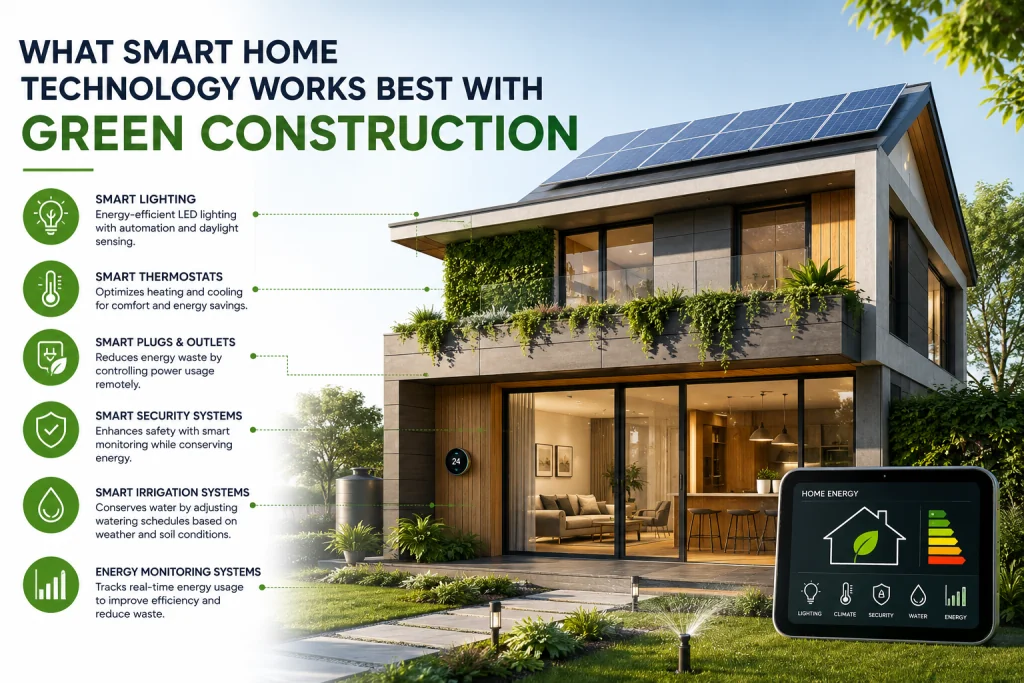
Heating and cooling account for the largest chunk of a home’s energy use. While green construction minimizes this load, smart thermostats (like Ecobee or Nest) optimize it.
- The Green Integration: Pair smart thermostats with smart zoning systems and integrated indoor air quality (IAQ) sensors. These devices learn the home’s thermal dynamics and the occupants' schedules, adjusting temperatures based on real-time occupancy and local weather forecasts. This ensures you aren't over-conditioning a tightly sealed, highly insulated envelope.
2. Automated Shading and Smart Window Controls
Passive solar design is a hallmark of green construction, utilizing the sun’s energy in the winter and blocking it in the summer. However, the sun’s angle changes throughout the day and the seasons.
- The Green Integration: Motorized smart shades integrated with light and temperature sensors can automatically adjust throughout the day. In the winter, they open to allow solar heat gain; in the summer, they close to block glare and reduce cooling loads. This drastically reduces the mechanical load on your HVAC system.
3. Whole-Home Energy Monitoring and Management
Today’s eco-conscious buyers want data. They want to see exactly how their green home is performing.
- The Green Integration: Install panel-level energy monitors (like Sense or Span) at the electrical panel. These systems use AI to identify the energy signature of individual appliances and provide real-time feedback to the homeowner via an app. For net-zero or solar-equipped homes, smart electrical panels can automatically route excess solar energy to an EV charger or a battery storage system, maximizing the use of renewable energy.
4. Smart Water Management and Leak Detection
Sustainability isn’t just about electricity; it’s also about water conservation and protecting the building materials.
- The Green Integration: Pair your low-flow fixtures and greywater systems with smart water shut-off valves (like Moen Flo or Phyn). These systems monitor water pressure and flow rates 24/7. If a microscopic leak is detected, the system automatically shuts off the water and alerts the homeowner. This conserves water and protects the sustainable, often moisture-sensitive, building materials (like engineered wood or specialized insulation) from catastrophic water damage.
5. Smart Lighting and Daylight Harvesting
LED lighting is a baseline in green construction, but smart lighting takes it to the next level.
- The Green Integration: Utilize smart switches, dimmers, and occupancy/vacancy sensors in low-traffic areas (pantries, garages, bathrooms). Integrate daylight harvesting sensors in rooms with large windows; these sensors automatically dim the artificial LEDs when natural sunlight is sufficient, ensuring zero wasted electricity.
Best Practices for Builders: Implementing Smart Tech on the Job Site
To successfully integrate technology and sustainability, the planning must happen before the drywall goes up. Here is how construction professionals can ensure a smooth integration:
- Future-Proof the Infrastructure: Always run Cat6 ethernet cables to key smart device locations (thermostats, access points, smart panels). Wi-Fi is great, but hardwired connections ensure the reliability required for a high-performance home. Ensure every switch box has a neutral wire to accommodate smart switches.
- Prioritize Interoperability: The days of walled-garden smart homes are over. Specify devices that support the Matter smart home standard. This ensures that the smart locks, thermostats, and lighting systems you install can communicate seamlessly with each other, regardless of the manufacturer, preventing future homeowner headaches and tech support calls to your office.
- Focus on the "Invisible" Tech: The best smart tech in a green home is the kind the homeowner doesn’t have to think about. Focus on automated sensors and background optimization rather than gimmicky gadgets.
- Provide a Comprehensive Handover: A green, smart home is only as efficient as the person living in it. Provide a detailed walkthrough and a digital "home manual" that explains how the automated systems work, how to read the energy monitoring app, and how to maintain the green features.
Integrating technology and sustainability is no longer a niche luxury; it is the new standard for premium homebuilding. By pairing the physical resilience of green construction with the intelligent optimization of smart home technology, you are offering your clients a home that is cheaper to operate, more comfortable to live in, and better for the planet.
For builders and developers, this integration is a powerful differentiator. It reduces post-construction callbacks, future-proofs the asset, and allows you to command a premium price in an increasingly eco-conscious real estate market.
Found this article valuable?
Share it with fellow builders, architects, or download the QR code.
Written by Shanmugam2026
Verified CreatorARQONZ Editorial Team brings you expert insights, construction guides, and architectural design trends from across the building industry.
Related Articles in Construction

What Should I Never Say to My Contractor?