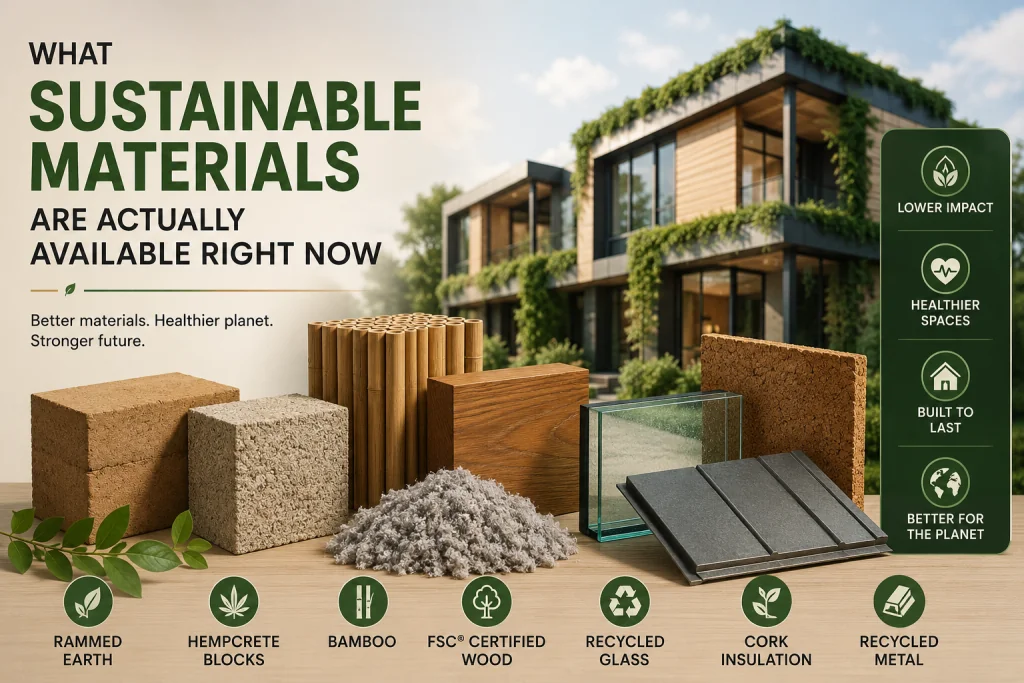
What Sustainable Materials Are Actually Available Right Now?
What Sustainable Materials Are Actually Available Right Now?
Meta Description: Cut through the greenwashing. Discover what sustainable construction materials are actually available today, featuring real product options, brand names, and actionable sourcing strategies for construction professionals.
Tags: #SustainableConstruction #GreenBuilding #EmbodiedCarbon #ConstructionMaterials #MassTimber #GreenConcrete #Procurement
If you are an architect, general contractor, or developer, you already know the pressure is on. Between tightening building codes, corporate ESG (Environmental, Social, and Governance) mandates, and client demands for net-zero goals, sustainable construction is no longer a niche selling point—it is the baseline.
But when you look at the market, it’s easy to get frustrated. How much of this is just "greenwashing"? What is actually commercially viable, code-compliant, and ready to be spec’d into your next project?
The good news? The gap between sustainable theory and construction reality has closed. Today, we are cutting through the noise to look at what sustainable materials are actually available right now, complete with real product options and actionable sourcing strategies.
1. Low-Carbon and Green Concrete
Concrete is the most consumed material on earth, and its cement component is a massive source of global CO2 emissions. Fortunately, the ready-mix industry has undergone a massive transformation. You no longer have to sacrifice compressive strength for sustainability.
Real Product Options:
- CarbonCure Technology: This isn't just a product; it's an injection technology. CarbonCure captures industrial CO2 and injects it into fresh concrete, where it mineralizes and permanently traps the carbon while increasing compressive strength.
- Holcim ECOPact: A range of low-carbon concrete solutions that utilize optimized mix designs and alternative binders (like calcined clay) to reduce embodied carbon by up to 90% compared to standard mixes, without compromising performance.
- Solidia Technologies: Utilizes a low-carbon cement that cures with CO2 rather than water, significantly reducing the carbon footprint of precast concrete products.
How to Source: Concrete is heavy, meaning transport emissions can negate material gains. Source locally. Contact your regional ready-mix suppliers and specifically ask if they utilize CarbonCure technology or offer low-carbon mix designs (like ECOPact). Most major national and regional suppliers now have these options readily available in their standard catalogs.
2. Mass Timber and Engineered Wood
Mass timber has graduated from an "emerging" trend to a mainstream structural solution. It sequesters carbon, speeds up construction timelines, and offers excellent fire and seismic performance when properly engineered.
Real Product Options:
- Cross-Laminated Timber (CLT) & Glulam: Look to industry leaders like Structurlam (North America) and Nordic Structures (Canada/US). They provide fully engineered, code-compliant CLT and glulam panels for mid- and high-rise structures.
- Kebony Modified Wood: For exterior cladding and decking, Kebony uses a proprietary bio-based liquid (derived from agricultural waste) to permanently modify softwood, giving it the durability and dark aesthetic of tropical hardwood without the deforestation.
How to Source: Mass timber requires early integration. Do not wait for the bidding phase. Engage with a Mass Timber Manufacturer or a specialized Timber Frame Erector during the schematic design phase. They will help you optimize panel sizes to minimize waste and connect you with certified local distributors to manage logistics and crane schedules.
3. High-Recycled Content Steel
Structural steel is highly recyclable, but the production method matters. Traditional blast furnaces are carbon-intensive. The sustainable alternative is steel produced in Electric Arc Furnaces (EAF), which melt down recycled scrap steel using electricity (increasingly sourced from renewables).
Real Product Options:
- Nucor Corporation & Commercial Metals Company (CMC): Both are massive US-based steel producers that primarily use EAF technology. Their rebar, structural beams, and decking often boast recycled content rates of 90% to 98%.
How to Source: When requesting bids from your steel fabricator or service center, explicitly mandate EAF-produced steel. More importantly, require them to provide Environmental Product Declarations (EPDs) for the specific mill runs. An EPD is a standardized document that details the exact embodied carbon and recycled content of the material, ensuring you aren't just taking the supplier's word for it.
4. Bio-Based and Recycled Insulation
The building envelope is critical for operational energy efficiency, but the insulation itself carries embodied carbon. Moving away from petroleum-based foams to bio-based and recycled alternatives is a highly effective way to lower a building's overall carbon footprint.
Real Product Options:
- Hempitecture (HempWool): Made from industrial hemp and a bio-based binder. It offers excellent thermal and acoustic performance, is vapor-permeable (preventing mold), and is carbon-negative.
- GreenFiber Cellulose Insulation: Made from 85%+ recycled post-consumer newsprint. It’s treated for fire and pest resistance and is a staple for dense-pack wall cavities and attic spaces.
- Mineral Wool (Rockwool / Thermafiber): While not "bio-based," stone wool is made from abundant natural basalt rock and recycled slag. It is non-combustible, water-repellent, and highly durable.
How to Source: For cellulose and mineral wool, your standard local insulation distributors will carry these products. For specialized bio-based materials like HempWool or mycelium-based acoustic panels, you will need to source directly from the manufacturer or through specialized sustainable building distributors like 475 High Performance Building Supply or BuildingGreen.
The Ultimate Sourcing Toolkit for Construction Pros
Knowing what to buy is only half the battle. Knowing how to verify and source it is what separates greenwashing from genuine sustainable construction. Here is your sourcing toolkit:
- Demand EPDs (Environmental Product Declarations): Never accept "eco-friendly" as a spec. Require an EPD. This is the nutrition label for building materials, detailing exact embodied carbon (kgCO2e).
- Use the EC3 Tool: The Embodied Carbon in Construction Calculator (EC3) is a free, industry-standard database. It allows you to benchmark, assess, and reduce embodied carbon by comparing the EPDs of materials from hundreds of suppliers.
- Leverage Mindful Materials: Use the Mindful Materials library to search for products that have been vetted for health, sustainability, and transparency (looking for certifications like Cradle to Cradle, Declare labels, and REDs).
- Factor in Transportation: A highly sustainable material shipped across the globe loses its green advantage. Always weigh the embodied carbon of the material against the emissions of transporting it to your specific job site.
Sustainable construction materials are no longer a concept for the future; they are sitting in the catalogs of your current suppliers. By specifying low-carbon concrete, EAF steel, mass timber, and bio-based envelopes—and by rigorously sourcing them using EPDs and tools like EC3—you can deliver projects that are profitable, code-compliant, and genuinely good for the planet.
Found this article valuable?
Share it with fellow builders, architects, or download the QR code.
Written by Shanmugam2026
Verified CreatorARQONZ Editorial Team brings you expert insights, construction guides, and architectural design trends from across the building industry.
Related Articles in Construction

What Should I Never Say to My Contractor?