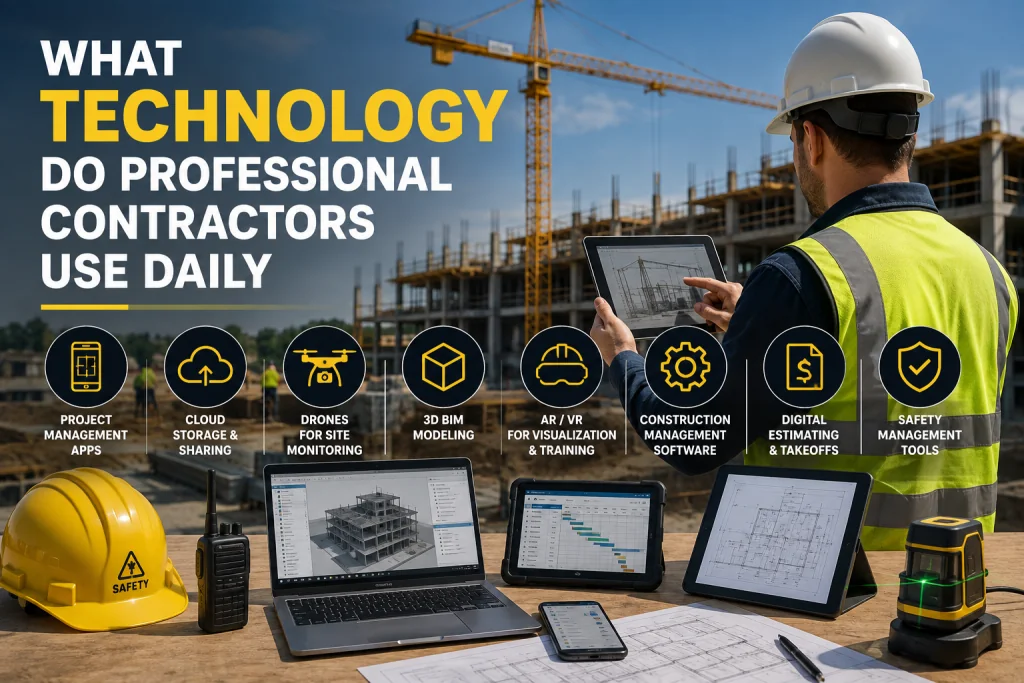
What Technology Do Professional Contractors Use Daily?
What Technology Do Professional Contractors Use Daily?
The construction industry has undergone a massive digital transformation over the last decade. The days of relying solely on paper blueprints, clipboards, and gut feelings are officially behind us. Today, profit margins are tight, labor is scarce, and project complexities are higher than ever. To survive and thrive, contractors must leverage the right tools.
But with thousands of construction software and hardware solutions on the market, it can be overwhelming to figure out what actually moves the needle.
If you are looking to modernize your operations or simply curious about the industry's digital frontier, you are in the right place. Let’s explore the daily tech stack that separates the good from the great.
1. Cloud-Based Project Management Platforms (The Digital Hub)
Successful contractors no longer manage projects through endless email chains and scattered spreadsheets. The backbone of any modern construction firm is a centralized, cloud-based project management platform.
What they use: Industry leaders like Procore, Autodesk Construction Cloud, and Buildertrend. How they use it daily:
- Single Source of Truth: Ensuring the field and the office are always looking at the exact same, most up-to-date drawings.
- Workflow Automation: Streamlining daily tasks like Requests for Information (RFIs), submittals, and daily logs.
- Financial Management: Tracking budgets, change orders, and invoices in real-time to prevent margin erosion.
2. Digital Takeoff and Estimating Software
Winning work is only half the battle; winning profitable work is the real challenge. Professional contractors rely on digital estimating tools to ensure their bids are both competitive and accurate.
What they use: Bluebeam Revu, PlanSwift, and HeavyBid. How they use it daily:
- Rapid Quantification: Quickly measuring areas, counts, and lengths directly from digital PDF plans.
- Historical Data Integration: Pulling data from past projects to create highly accurate, data-driven estimates.
- Collaborative Bidding: Allowing multiple estimators to work on different sections of a massive project simultaneously in the cloud.
3. Field Management and Mobile Daily Reporting Apps
The gap between the job site trailer and the main office is where projects often lose money. Successful contractors use mobile field apps to bridge this gap, ensuring that what happens in the dirt is instantly visible to the back office.
What they use: Fieldwire, Raken, and PlanGrid. How they use it daily:
- Digital Daily Logs: Superintendents use tablets to log weather, manpower, equipment usage, and work completed in just a few taps.
- Punch List Management: Snapping photos of defects, assigning them to specific subcontractors, and tracking their resolution in real-time.
- Safety Compliance: Digitally signing off on toolbox talks and logging near-misses to maintain a pristine safety record.
4. Building Information Modeling (BIM) and VDC Tools
For commercial and large-scale residential contractors, 2D plans are no longer enough. Virtual Design and Construction (VDC) and BIM are daily necessities for coordinating complex MEP (Mechanical, Electrical, and Plumbing) systems.
What they use: Autodesk Revit, Navisworks, and BIM 360. How they use it daily:
- Clash Detection: Running 3D models through coordination software to find where a ductwork run intersects with a structural beam before it becomes a costly rework issue in the field.
- 4D Scheduling: Linking the 3D model to the project schedule to visualize the construction sequence and optimize site logistics.
- Prefabrication: Using highly accurate BIM models to build MEP racks off-site, drastically reducing field labor hours.
5. Advanced Field Hardware: Drones, Scanners, and Wearables
Software is only as good as the data fed into it. Professional contractors are increasingly relying on advanced hardware to capture site data quickly and safely.
What they use: DJI Enterprise Drones, Trimble/Leica 3D Laser Scanners, and IoT Wearables. How they use it daily:
- Drone Mapping: Flying a drone weekly (or daily) to capture orthomosaic maps and calculate cut/fill volumes automatically, replacing days of manual surveying.
- 3D Laser Scanning: Scanning existing conditions or verifying that concrete pours were placed within millimeter tolerances before proceeding to the next trade.
- IoT and Wearables: Using smart vests or helmet attachments to monitor worker fatigue, track proximity to heavy equipment, and ensure compliance with site safety zones.
6. AI and Predictive Analytics
As we move through 2026, Artificial Intelligence has transitioned from a "buzzword" to a daily utility for top-tier contractors. AI is no longer just about generating text; it’s about predicting outcomes.
What they use: AI-integrated modules within their existing PM software, and specialized tools like ALICE Technologies or nPlan. How they use it daily:
- Schedule Optimization: AI analyzes thousands of past project schedules to suggest the most efficient sequencing for the current project, predicting bottlenecks before they happen.
- Risk Management: Machine learning algorithms scan daily reports, RFIs, and weather data to flag projects that are at a high risk of going over budget or past their deadline, allowing PMs to intervene early.
The question isn't whether professional contractors should use technology; it's about which technologies will yield the highest return on investment for their specific business model.
The most successful contractors don't just buy software and hope for the best. They carefully select a tech stack that integrates seamlessly, train their crews thoroughly, and use the data they collect to make smarter, faster decisions. By relying on cloud management, mobile field apps, BIM, and advanced hardware, they protect their margins, keep their crews safe, and deliver projects on time.
Found this article valuable?
Share it with fellow builders, architects, or download the QR code.
Written by Shanmugam2026
Verified CreatorARQONZ Editorial Team brings you expert insights, construction guides, and architectural design trends from across the building industry.
Related Articles in Construction

What Should I Never Say to My Contractor?