What's the Difference Between Eco-Friendly and Sustainable Building?
What's the Difference Between Eco-Friendly and Sustainable Building?
In the modern construction industry, "green" building is no longer a niche differentiator; it is a baseline expectation. However, as environmental regulations tighten and client demands evolve, the terminology surrounding green building has become a tangled web of buzzwords.
For developers, general contractors, architects, and project managers, two terms are frequently—and incorrectly—used interchangeably: eco-friendly and sustainable.
While both concepts aim to reduce the construction industry’s massive environmental footprint, they represent fundamentally different approaches to project delivery. Understanding the distinction is not just an exercise in semantics; it is critical for accurate bidding, effective lifecycle planning, and meeting the increasingly complex demands of modern stakeholders.
Here is a professional breakdown of the differences between eco-friendly and sustainable building, and why it matters for your next project.
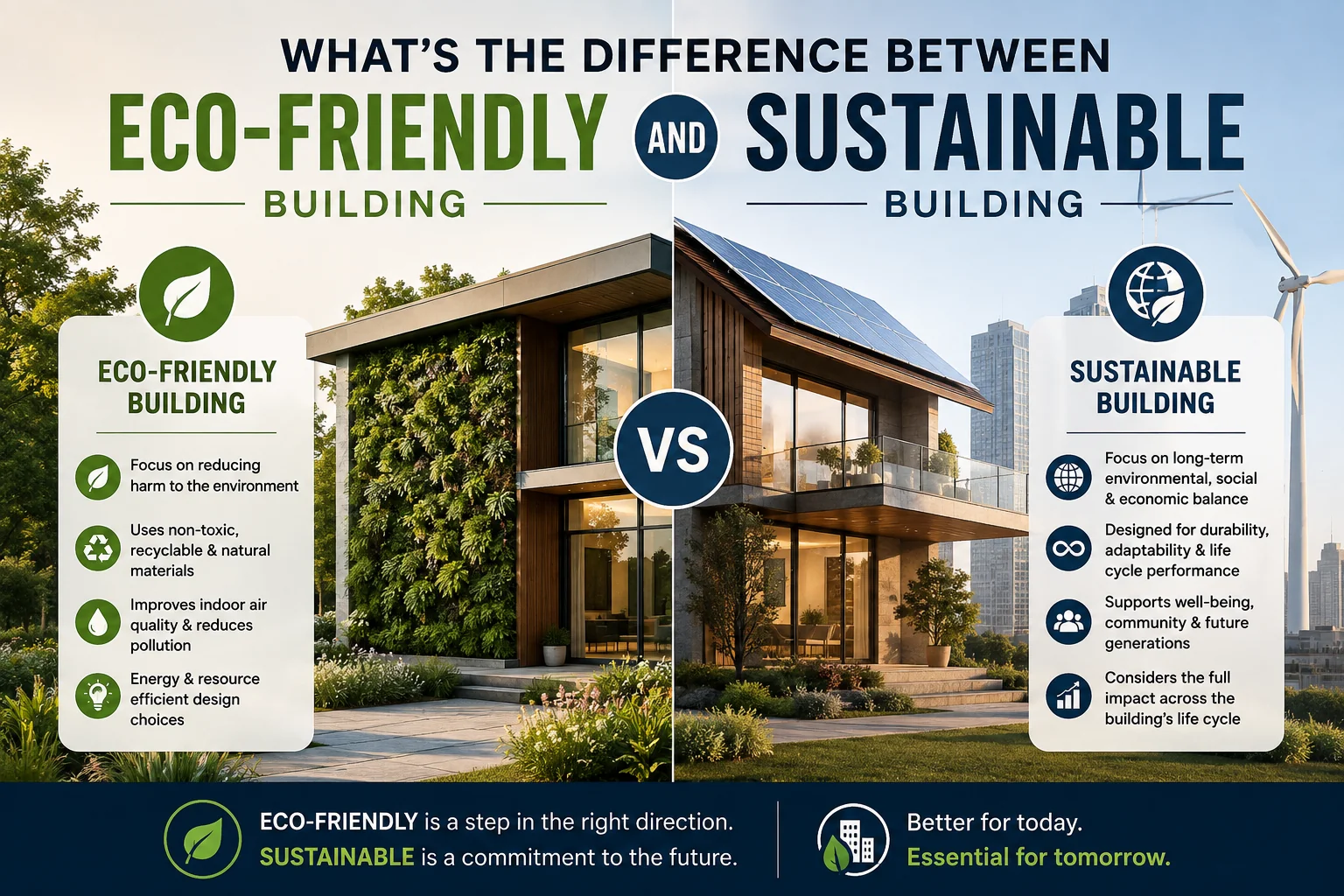
Eco-Friendly Building: Minimizing Environmental Harm
Eco-friendly building (often referred to as "green building" in a narrow sense) focuses primarily on reducing the negative environmental impact of a structure. It is highly product- and tactic-centric.
When a project is marketed as eco-friendly, the focus is usually on specific, measurable environmental interventions. The goal is to do less harm to the planet.
Common Eco-Friendly Practices in Construction:
- Material Selection: Using low-VOC paints, recycled steel, or rapidly renewable materials like bamboo.
- Waste Reduction: Implementing strict site waste management plans to divert debris from landfills.
- Resource Conservation: Installing low-flow plumbing fixtures or using drought-tolerant landscaping to reduce water consumption.
- Toxin Reduction: Ensuring indoor air quality by avoiding materials that off-gas harmful chemicals.
The Limitation: Eco-friendly building is often siloed. A building can use 100% recycled materials (eco-friendly) but be incredibly inefficient to heat and cool, or be built in a location that forces occupants to rely entirely on personal vehicles. It addresses the environmental symptom, but not necessarily the systemic cause.
Sustainable Building: A Holistic, Lifecycle Approach
Sustainable building is a much broader, holistic framework. It encompasses eco-friendly practices but expands the focus to include the Triple Bottom Line: Environmental, Economic, and Social viability.
Sustainability in construction is about creating systems that can be maintained indefinitely without depleting resources, compromising the economy, or harming the well-being of the community. It shifts the focus from simply "doing less harm" to "creating long-term, regenerative value."
Common Sustainable Practices in Construction:
- Lifecycle Assessment (LCA): Evaluating the environmental and economic impact of a building from material extraction (embodied carbon) through operation and eventual demolition.
- Economic Viability: Designing for long-term operational savings and durability, ensuring the building makes financial sense over a 50- or 100-year horizon, not just at the point of initial construction.
- Social Equity and Well-being: Designing spaces that promote occupant health, utilize natural daylighting, and integrate seamlessly into the local community without causing gentrification or displacement.
- Resilience and Adaptability: Engineering structures to withstand future climate impacts (e.g., extreme weather, rising sea levels) and designing flexible floor plans that allow the building to be repurposed over time, preventing premature obsolescence.
The Core Differences: A Quick Comparison
To clarify the concepts for your project teams and clients, here is a high-level comparison:
| Feature | Eco-Friendly Building | Sustainable Building |
|---|---|---|
| Primary Focus | Environmental protection and reducing harm. | Balancing Environmental, Economic, and Social factors. |
| Scope | Narrow; often focuses on specific materials or systems. | Broad; holistic approach to the entire building lifecycle. |
| Timeframe | Short-to-medium term (immediate impact during construction). | Long-term (50+ year lifecycle, operational, and legacy impact). |
| Mindset | "How can we build this with less environmental damage?" | "How can we build this to thrive for the next century?" |
| Metrics | Recycled content percentages, water saved, waste diverted. | Return on Investment (ROI), lifecycle carbon, occupant health, community impact. |
In short: Eco-friendly is a feature of a building; sustainable is a framework.
You might be asking: Does this semantic difference actually impact my day-to-day operations? The answer is a resounding yes.
Why This Distinction Matters for Construction Professionals
1. Accurate Bidding and Value Engineering
If a client asks for an "eco-friendly" building, they may simply want you to swap out standard materials for green alternatives. If they ask for a "sustainable" building, you must engage in early-stage lifecycle costing. Value engineering a sustainable building isn't about finding the cheapest upfront material; it's about finding the material that offers the best performance, durability, and lifecycle ROI.
2. Navigating Certifications and Regulations
Certification systems like LEED, BREEAM, and the Living Building Challenge have evolved. While early versions heavily weighted eco-friendly material checklists, modern iterations heavily penalize buildings that ignore holistic sustainability, such as transportation impacts, economic resilience, and occupant well-being. Understanding the difference ensures your project actually achieves the targeted certification.
3. Managing Client Expectations and Risk
Developers and owners are increasingly aware of "greenwashing." If you pitch a project as sustainable but only deliver eco-friendly tactics (e.g., installing solar panels on a poorly insulated, highly inefficient building envelope), you risk reputational damage and future liability. Aligning your project delivery methods with true sustainability mitigates long-term risk.
4. Future-Proofing the Asset
The construction industry is rapidly moving toward strict carbon mandates, including embodied carbon limits in local building codes. Projects designed with a sustainable, lifecycle mindset are inherently future-proofed against these regulatory shifts, whereas purely eco-friendly projects may require costly retrofits down the line.
As the construction industry moves further into the 2020s, the margin for error regarding environmental impact is shrinking. Eco-friendly building is a vital stepping stone and a necessary component of modern construction, but it is no longer the finish line.
True sustainable building requires us to look beyond the immediate site boundaries and the initial construction budget. It demands that we act as stewards of the environment, the economy, and the communities we build within.
By clarifying these terms internally and educating your clients on the difference, you position your firm not just as a builder of structures, but as a partner in long-term, resilient value creation.
Found this article valuable?
Share it with fellow builders, architects, or download the QR code.
Written by Shanmugam2026
Verified CreatorARQONZ Editorial Team brings you expert insights, construction guides, and architectural design trends from across the building industry.
Related Articles in Construction

What Should I Never Say to My Contractor?