What's the Real Cost Difference Between Green and Traditional Construction?
What's the Real Cost Difference Between Green and Traditional Construction?
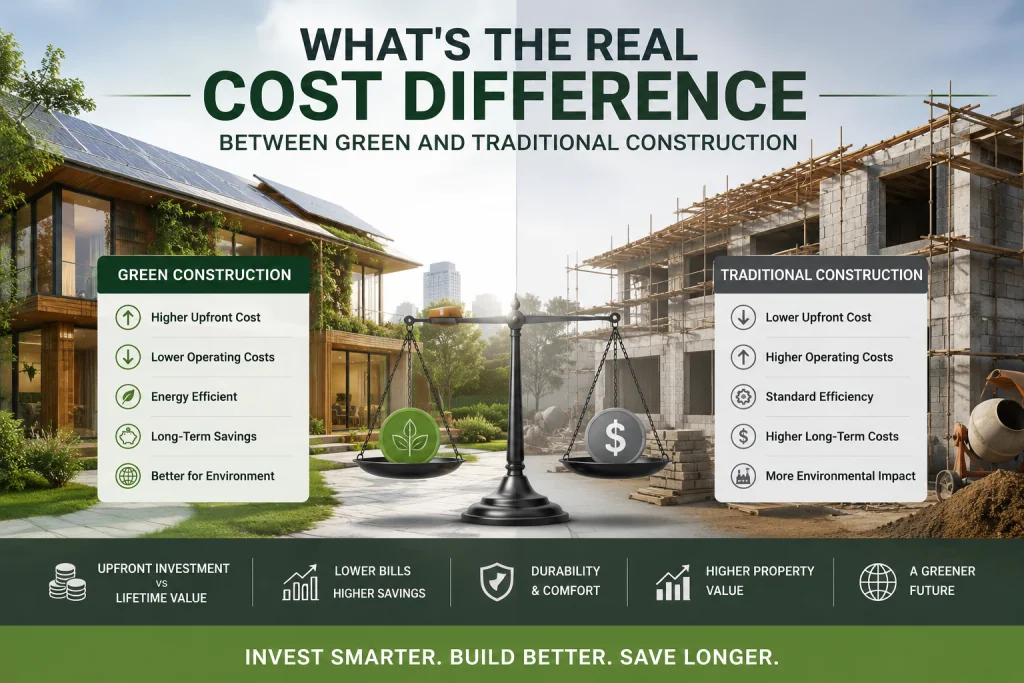
For decades, the construction industry has been locked in a persistent debate: Is sustainable building a financial burden or a strategic investment?
Historically, the narrative was simple—green construction costs significantly more upfront than traditional methods. However, as supply chains for sustainable materials have matured and energy costs have fluctuated, that narrative has evolved. Today, project owners, developers, and contractors must look beyond the initial price tag.
To truly understand the real cost difference between green and traditional construction, we must shift our focus from short-term expenses to long-term value. This requires rigorous budget planning and a comprehensive financial comparison that accounts for the entire lifecycle of the building.
Here is a professional breakdown of the real costs, how to plan your budget, and the financial metrics you need to compare both approaches accurately.
The Upfront Myth: Capital Expenditures (CapEx)
When comparing costs, the most immediate difference appears in the Capital Expenditures (CapEx)—the initial construction budget.
Traditional Construction: Traditional building relies on established, mass-produced materials and conventional HVAC systems. The upfront costs are highly predictable, and the supply chain is deeply entrenched, keeping initial bids competitive.
Green Construction: Sustainable building often requires specialized materials (e.g., mass timber, low-VOC finishes, high-performance glazing) and advanced systems (e.g., geothermal heating, solar arrays, smart building management systems).
The Reality Check: It is true that green construction carries a "green premium." However, industry data shows this premium is shrinking. For standard LEED or BREEAM-certified buildings, the upfront cost premium is typically between 1% and 5%. For highly ambitious projects (like Net-Zero or Living Building Challenge), the premium can range from 5% to 10%.
While this initial bump is real, judging a project solely on CapEx is a flawed financial strategy.
The Hidden Savings: Operational Expenditures (OpEx)
The true financial divergence between green and traditional construction reveals itself in Operational Expenditures (OpEx). Traditional buildings are financial drains over their 30- to 50-year lifespans, whereas green buildings are designed to be financially efficient.
- Energy Efficiency: Green buildings typically consume 20% to 30% less energy than traditional baselines. In an era of volatile energy markets, this translates to massive, predictable savings.
- Water Conservation: Low-flow fixtures, rainwater harvesting, and greywater recycling can reduce water usage by 20% to 50%, directly lowering utility overhead.
- Maintenance and Durability: Sustainable materials often boast longer lifespans and higher durability. While a traditional roof might need replacing in 15 years, a green roof or high-performance metal roof can last 40+ years, drastically reducing lifecycle maintenance costs.
Budget Planning: How to Accurately Forecast Costs
To accurately compare green and traditional construction, your budget planning must evolve. You cannot use a standard 2D estimating sheet for a holistic financial comparison. Here is how to plan effectively:
1. Implement Life Cycle Cost Analysis (LCCA)
Move away from simple initial-cost estimating. LCCA evaluates the total cost of ownership over the building's lifecycle. By factoring in initial costs, energy use, maintenance, replacement costs, and residual value, LCCA provides a mathematically sound basis for comparing green vs. traditional options.
2. Factor in Incentives and Subsidies
Budget planning for green construction must include local, state, and federal incentives. Tax credits, density bonuses, expedited permitting, and utility rebates can offset 10% to 30% of the initial "green premium," sometimes making the upfront CapEx virtually identical to traditional construction.
3. Integrate Cost Modeling Early
In traditional construction, sustainability is often value-engineered out of the project when budgets get tight. In green construction, integrate cost modeling during the pre-design phase. This allows the team to find the most cost-effective sustainable strategies (like optimizing building orientation for passive solar gain) before expensive materials are even selected.
Financial Comparison: Key Metrics to Evaluate
When presenting a financial comparison to stakeholders, investors, or owners, rely on these core financial metrics to prove the viability of green construction:
1. The Payback Period
This is the time it takes for the operational savings of a green building to recoup the initial "green premium." For most commercial green buildings, the simple payback period for sustainable upgrades ranges from 3 to 7 years. Given that a commercial building's lifespan is 40+ years, this leaves decades of pure financial benefit.
2. Return on Investment (ROI) and Net Present Value (NPV)
Calculate the ROI of specific green interventions. For example, upgrading to a high-efficiency HVAC system might have an upfront cost of $100,000 but save $15,000 annually. Using NPV, you can discount those future savings to today’s dollars, proving that the green investment yields a higher financial return than putting that same capital into low-yield traditional savings.
3. Asset Value and Revenue Generation
Green buildings generate higher revenues. Studies consistently show that LEED-certified or Energy Star-rated buildings command higher rental rates (often 3% to 8% higher) and experience lower vacancy rates. Furthermore, upon resale, green buildings typically see a "green asset premium," appraising for 5% to 10% more than comparable traditional buildings.
4. Risk Mitigation and Future-Proofing
Traditional construction carries hidden financial liabilities. As governments implement stricter carbon taxes, energy codes, and emissions mandates (such as Local Law 97 in NYC), traditional buildings face massive retrofitting costs or financial penalties. Budgeting for green construction is essentially budgeting for risk mitigation, protecting the asset against future regulatory obsolescence.
So, what is the real cost difference between green and traditional construction?
If you only look at the day the building opens, traditional construction is cheaper. But construction is not a short-term game. When you apply rigorous budget planning and a comprehensive financial comparison that includes lifecycle costs, operational savings, increased asset value, and risk mitigation, green construction is almost always the more financially sound choice.
For construction professionals, the message is clear: the future of the industry belongs to those who can accurately quantify and communicate the long-term financial value of sustainable building. It is no longer just about building green to save the planet; it is about building green to save the bottom line.
Found this article valuable?
Share it with fellow builders, architects, or download the QR code.
Written by Shanmugam2026
Verified CreatorARQONZ Editorial Team brings you expert insights, construction guides, and architectural design trends from across the building industry.
Related Articles in Construction

What Should I Never Say to My Contractor?