What's the Timeline for Seeing Energy Savings From Green Upgrades?
What's the Timeline for Seeing Energy Savings From Green Upgrades?
As construction professionals, developers, and project managers, we have all sat across the table from a client who is eager to incorporate sustainable design into their project. They want the LEED certification, the lower carbon footprint, and the marketing prestige of a "green" building. But inevitably, the conversation pivots to the bottom line, and they ask the ultimate question:
"When will I actually see the return on this investment?"
Selling green building isn’t just about environmental stewardship; it’s about financial predictability. However, the timeline for realizing energy savings is not a one-size-fits-all metric. To manage client expectations and structure realistic project proposals, construction professionals must understand the varying payback periods of different energy efficiency measures.
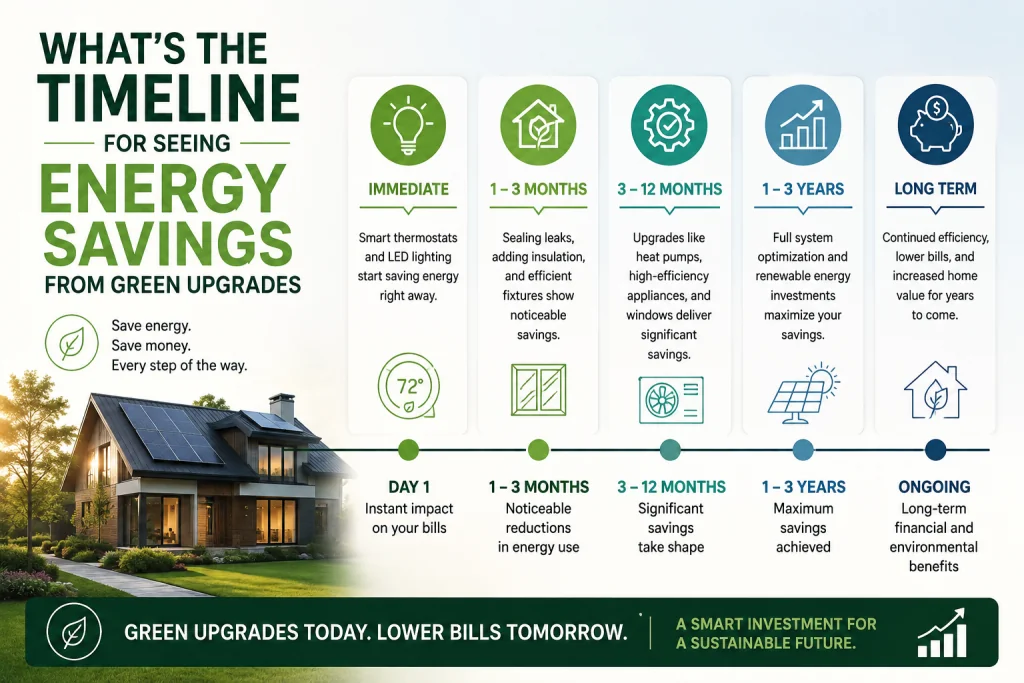
Here is a realistic breakdown of the timeline for seeing energy savings from green upgrades, categorized by short, medium, and long-term projections.
1. The Short-Term Wins: 0 to 3 Years
The Upgrades: Low-hanging fruit and operational tweaks. Realistic Projection: 1 to 3-year payback period.
When clients want quick wins to offset initial capital expenditures, focus on upgrades that require minimal structural disruption and offer immediate utility bill reductions.
- LED Lighting Retrofits & Smart Controls: Transitioning to commercial-grade LED lighting paired with occupancy sensors and daylight harvesting controls. The energy drop is immediate, and the hardware cost has plummeted over the last few years.
- Advanced Air Sealing and Insulation: In both new builds and retrofits, blower-door tested air sealing and upgrading to high-R-value insulation (like spray foam or mineral wool) drastically reduce HVAC loads from day one.
- Smart Thermostats and Basic EMS: Upgrading to modern, networked Energy Management Systems (EMS) that optimize HVAC scheduling based on real-time occupancy.
The Takeaway for Builders: Use these upgrades as the "hook." They are easy to justify to skeptical clients because the initial capital outlay is low, and the operational savings begin the moment the certificate of occupancy is issued.
2. The Medium-Term Investments: 3 to 7 Years
The Upgrades: Core mechanical, electrical, and envelope improvements. Realistic Projection: 4 to 7-year payback period.
This is the sweet spot for most commercial and high-end residential green projects. These upgrades require a higher upfront capital investment but fundamentally improve the building's baseline performance.
- High-Efficiency HVAC Systems: Installing Variable Refrigerant Flow (VRF) systems, commercial cold-climate heat pumps, or energy recovery ventilators (ERVs). By 2026, heat pump technology has matured significantly, making electrification highly cost-effective in most climate zones.
- Building Envelope Upgrades: Installing triple-pane, low-E glazing, or adding continuous exterior insulation. While expensive, the reduction in thermal bridging and HVAC load provides steady, compounding savings.
- Rooftop Solar PV (Without Heavy Battery Storage): Grid-tied solar arrays still offer a highly predictable 4-to-6-year payback in areas with high commercial utility rates and favorable net-metering or time-of-use (TOU) rate structures.
The Takeaway for Builders: When proposing these systems, shift the conversation from "payback period" to Lifecycle Cost Analysis (LCCA). Show the client that while the payback takes five years, the system will continue to generate pure profit (via avoided energy costs) for the remaining 15–20 years of its lifespan.
3. The Long-Term Commitments: 7 to 15+ Years
The Upgrades: Deep energy retrofits and cutting-edge systemic integrations. Realistic Projection: 8 to 15+ year payback period (but massive asset value increase).
These are the heavy hitters. They often require significant construction downtime, complex engineering, or major structural alterations. The pure "energy savings" payback may take a decade, but the secondary financial benefits make them worthwhile.
- Geothermal Ground-Source Heat Pumps: The drilling and ground-loop installation costs are steep. However, the extreme efficiency and low maintenance costs of geothermal systems yield incredible long-term savings and virtually eliminate mechanical replacement costs for decades.
- Green Roofs and Cool Pavements: Beyond the energy savings (reducing the urban heat island effect and lowering cooling loads), these offer massive ROI through extended roof lifespans, stormwater management fee reductions, and enhanced tenant well-being.
- AI-Driven Building Automation Systems (BAS): Integrating a fully autonomous, AI-optimized BAS that learns building usage patterns and dynamically adjusts lighting, HVAC, and plug loads. The software and sensor integration costs are high, but the ongoing optimization pushes the building closer to true net-zero.
The Takeaway for Builders: For these upgrades, energy savings are only part of the story. You must sell the asset value. Green buildings with deep retrofits command higher lease rates, experience lower tenant turnover, and boast higher resale valuations. The ROI is realized in the balance sheet of the property's overall value, not just the monthly utility bill.
Variables That Shift the Timeline
When presenting these projections to a client, remind them that the timeline is fluid. Several external factors will accelerate or delay the ROI:
- Utility Rate Structures: If the local grid has shifted heavily toward Time-of-Use (TOU) pricing, upgrades that allow for "peak shaving" (like thermal energy storage or solar+battery microgrids) will see a drastically accelerated payback.
- Incentives and Tax Credits: Always run the numbers through the latest local, state, and federal incentive programs. A 7-year payback can easily become a 4-year payback if a 30% tax credit or local utility rebate is applied to the initial construction cost.
- Climate Zone: A high-performance building envelope will see a much faster payback in a climate with extreme temperature swings (e.g., Zone 4 or 5) compared to a mild coastal climate.
- Building Operations: A building that operates 24/7 (like a hospital or data center) will realize energy savings much faster than a standard 9-to-5 office space, simply because the baseline energy consumption is so much higher.
Clients don't just want a green building; they want a financially sound asset. By breaking down the timeline for energy savings into short, medium, and long-term projections, you transition the conversation from an emotional debate about "saving the planet" to a rational discussion about risk mitigation and long-term profitability.
Found this article valuable?
Share it with fellow builders, architects, or download the QR code.
Written by Shanmugam2026
Verified CreatorARQONZ Editorial Team brings you expert insights, construction guides, and architectural design trends from across the building industry.
Related Articles in Construction

What Should I Never Say to My Contractor?