Why Is Construction So Loud and How Long Does It Last?
Why Is Construction So Loud and How Long Does It Last?
As industry professionals, we hear the rumble of diesel engines and the strike of pneumatic tools as the sound of progress. But to the surrounding community, clients, and site stakeholders, it is often perceived as a significant disruption. Noise complaints can lead to work stoppages, strained community relations, and reputational damage.
To effectively manage construction noise, we must first demystify it. By understanding exactly why job sites generate so much decibel power and how long these high-noise phases actually last, project managers and contractors can better plan their operations, mitigate impacts, and set accurate expectations for stakeholders.
Here is a professional breakdown of construction noise sources and their typical durations.
Part 1: Why Is Construction So Loud? (Identifying the Sources)
Construction noise is not a monolith; it is a complex mix of impact, vibration, and airborne sound. The extreme volume on a job site generally stems from three primary categories:
1. Heavy Machinery and Impact Equipment
The most notorious offenders on any site are heavy earthmoving and structural equipment.
- Pile Drivers and Vibratory Rollers: Driving piles into the ground requires massive kinetic energy, resulting in low-frequency, high-decibel impact noise that travels long distances through the ground and air.
- Excavators and Loaders: The hydraulic whine combined with the clanking of steel buckets against rock or concrete creates a persistent, heavy industrial hum.
2. Material Processing and Cutting
Once materials are on-site, they must be shaped and fitted.
- Concrete and Masonry Cutting: Using diamond-blade saws on concrete, brick, or stone generates high-frequency, piercing noise.
- Grinding and Welding: Angle grinders and torch cutting produce sharp, intermittent spikes in decibel levels that are highly disruptive to the human ear.
3. Site Logistics and Traffic
A bustling job site is essentially a temporary, high-traffic industrial zone.
- Heavy Vehicle Traffic: The braking and accelerating of fully loaded dump trucks and cement mixers generate substantial noise.
- Backup Alarms: While modern sites are increasingly adopting smart, broadband (white noise) backup alarms that dissipate quickly, traditional "beep-beep" alarms remain a major source of localized, high-pitched noise.
Part 2: How Long Does It Last? (Mapping the Duration)
A common misconception among the public and project owners is that construction sites operate at maximum volume from groundbreaking to ribbon-cutting. In reality, noise on a construction site follows a distinct lifecycle.
The loudest phases are typically the shortest, while the quieter phases last the longest. Here is how the noise timeline generally breaks down:
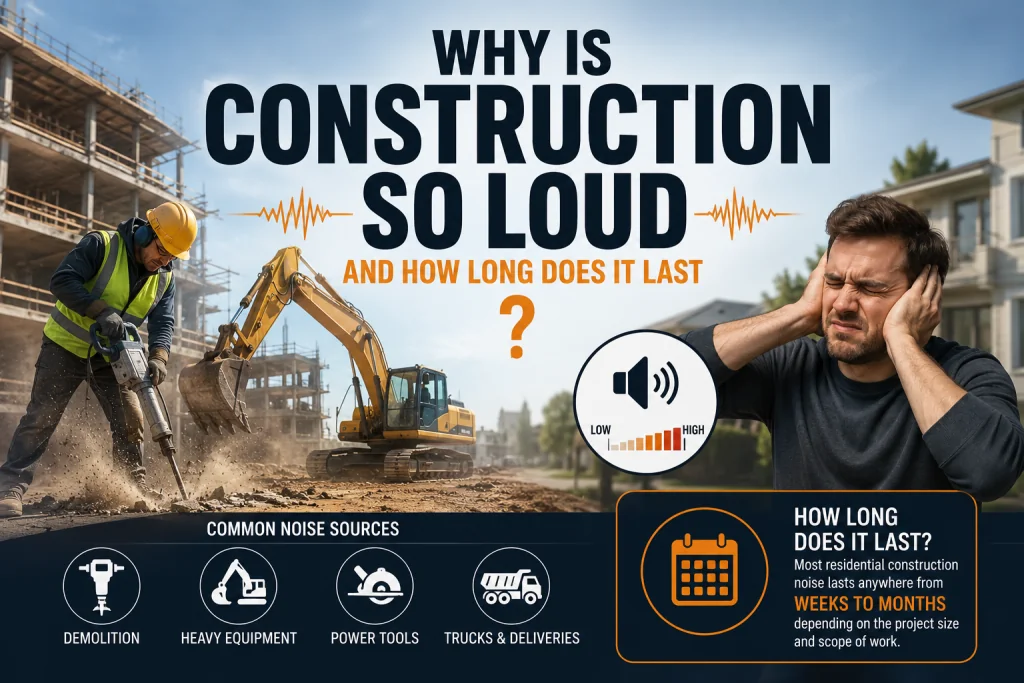
Phase 1: Site Preparation and Demolition (Weeks 1 to 4)
- Noise Level: Extreme (90–110+ dB)
- Duration: Short
- The Reality: This is the most disruptive phase. Excavators tearing up pavement, jackhammers breaking concrete, and heavy haulage moving debris off-site create a chaotic soundscape. However, because site prep is relatively brief, the extreme noise is usually contained to a matter of weeks.
Phase 2: Substructure and Superstructure (Months 2 to 8)
- Noise Level: High (80–95 dB)
- Duration: Medium
- The Reality: As the foundation is poured and the steel or concrete frame goes up, the noise shifts from sharp impacts to sustained mechanical noise. Concrete pumps, crane operations, and steel erection dominate this phase. While still loud, the noise becomes more predictable and rhythmic.
Phase 3: Enclosure, MEP, and Finishes (Months 6 to 18+)
- Noise Level: Moderate to Low (60–80 dB)
- Duration: Long
- The Reality: Once the building is "dried in" (enclosed), exterior noise drops dramatically. The work shifts indoors to Mechanical, Electrical, and Plumbing (MEP) rough-ins, drywall, and finishing. While interior noise can be an issue for early occupants, the exterior community impact is minimal.
The Golden Rule of Construction Noise: The peak decibel levels occur at the very beginning of the project and rapidly decrease as the project progresses.
Part 3: How the Industry Can Manage the Impact
Understanding the sources and duration of noise is only half the battle. As construction professionals, it is our responsibility to actively manage these factors. Here are best practices for modern job sites:
- Batch the High-Noise Tasks: Don't spread noisy activities out over weeks. Consolidate demolition, core drilling, and heavy cutting into specific, designated "high-noise days."
- Invest in Modern, Quiet Technology: The shift toward electric and hybrid heavy equipment is accelerating. Utilizing electric compact track loaders or silent concrete crushers can drastically reduce decibel output. Furthermore, ensure all equipment is fitted with modern acoustic blankets and broadband backup alarms.
- Implement Physical Barriers: Deploy acoustic fencing, sound blankets around perimeter scaffolding, and temporary noise barriers around stationary equipment like generators and compressors.
- Master the Art of Communication: The fastest way to defuse a noise complaint is the "No Surprises" approach. Before the loud demolition phase begins, notify the surrounding community. Tell them what will be happening, why it is necessary, and exactly how many days it will last. When people know the end date of the disruption, their tolerance increases exponentially.
Construction noise is an unavoidable byproduct of building the infrastructure, homes, and commercial spaces our society relies on. However, by deeply understanding the mechanical sources of this noise and mapping its duration across the project lifecycle, construction firms can transition from reactive damage control to proactive noise management.
When we respect the acoustic environment as much as the physical one, we build not just better structures, but better relationships with the communities we build them in
Found this article valuable?
Share it with fellow builders, architects, or download the QR code.
Written by Shanmugam2026
Verified CreatorARQONZ Editorial Team brings you expert insights, construction guides, and architectural design trends from across the building industry.
Related Articles in Construction

What Should I Never Say to My Contractor?